
Floor Repair Denton, TX — Fix Dents, Buckles, Squeaks & “Can’t-Unsee-It” Damage Without Replacing the Whole Floor
JBN Flooring repairs real-life wear: dropped cast-iron pans, chair gouges, pet scratches, swollen seams after a leak, and plank damage from shifting North Texas slabs. We match boards, rebuild transitions, and make repairs blend—so your floor looks intentional again.
Learn more about JBN Flooring or request an evaluation—either way, you’ll get straight answers about what will actually hold up.
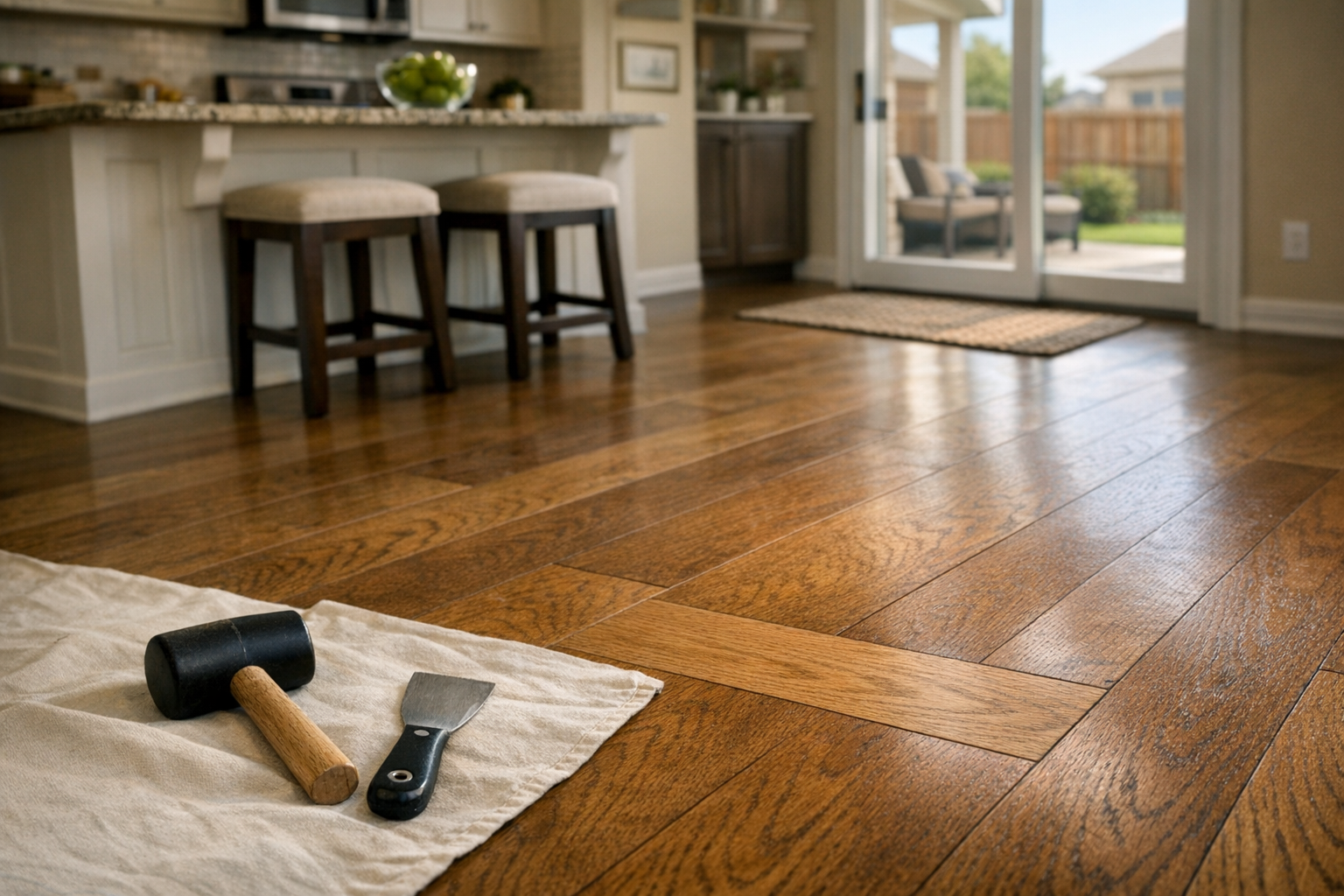
Quick Answer: “Can My Floor Be Repaired, Or Do I Need Replacement?” (What We Check On-Site)
If you’re hoping for “just fix that spot,” you’re thinking like most Denton homeowners—and you’re not wrong. The difference is whether the system underneath that spot is stable. We don’t make the call from one close-up photo because the same-looking defect can have two very different causes: a surface problem you can blend, or a movement/moisture problem that will reopen the repair.
On-site, we check the floor type, installation method, movement clues, and match strategy. The goal is a repair that makes sense with how your home actually behaves—open-concept sight lines, bright west-facing sun, and the expansion/contraction cycle that hits North Texas floors harder than many homeowners expect.
- We start by identifying the floor system, not just the surface—solid hardwood vs engineered wood vs laminate vs LVP, then how it’s installed (nail-down, glue-down, floating), because repair options change dramatically based on the build-up and locking mechanism.
- We look for movement clues you can’t see in photos: hollow spots from glue failure, edge lift at seams, squeaks tied to fastener pattern, and subtle cupping that often shows up after Denton’s humidity swings or after an HVAC change.
- We check whether the damage is cosmetic (dent, scratch, finish wear) or structural (swollen core, delamination, broken tongue-and-groove, subfloor deflection), because a cosmetic fix on structural damage usually fails within weeks.
- We confirm material availability and match strategy: whether we can weave in a donor plank from a closet, source the same SKU, or custom-tint stain/fill and feather a finish—especially common when homeowners have a 7–12 year old floor that’s been discontinued.
- We map the repair boundary to natural stopping points like thresholds, stair noses, cabinetry toe kicks, and transition strips so the final result reads as seamless, not like a patched square in the middle of the room.
If you want the fastest next step, call 469-340-0837 and tell us the material (if you know it), where the damage is, and whether there was water involved.
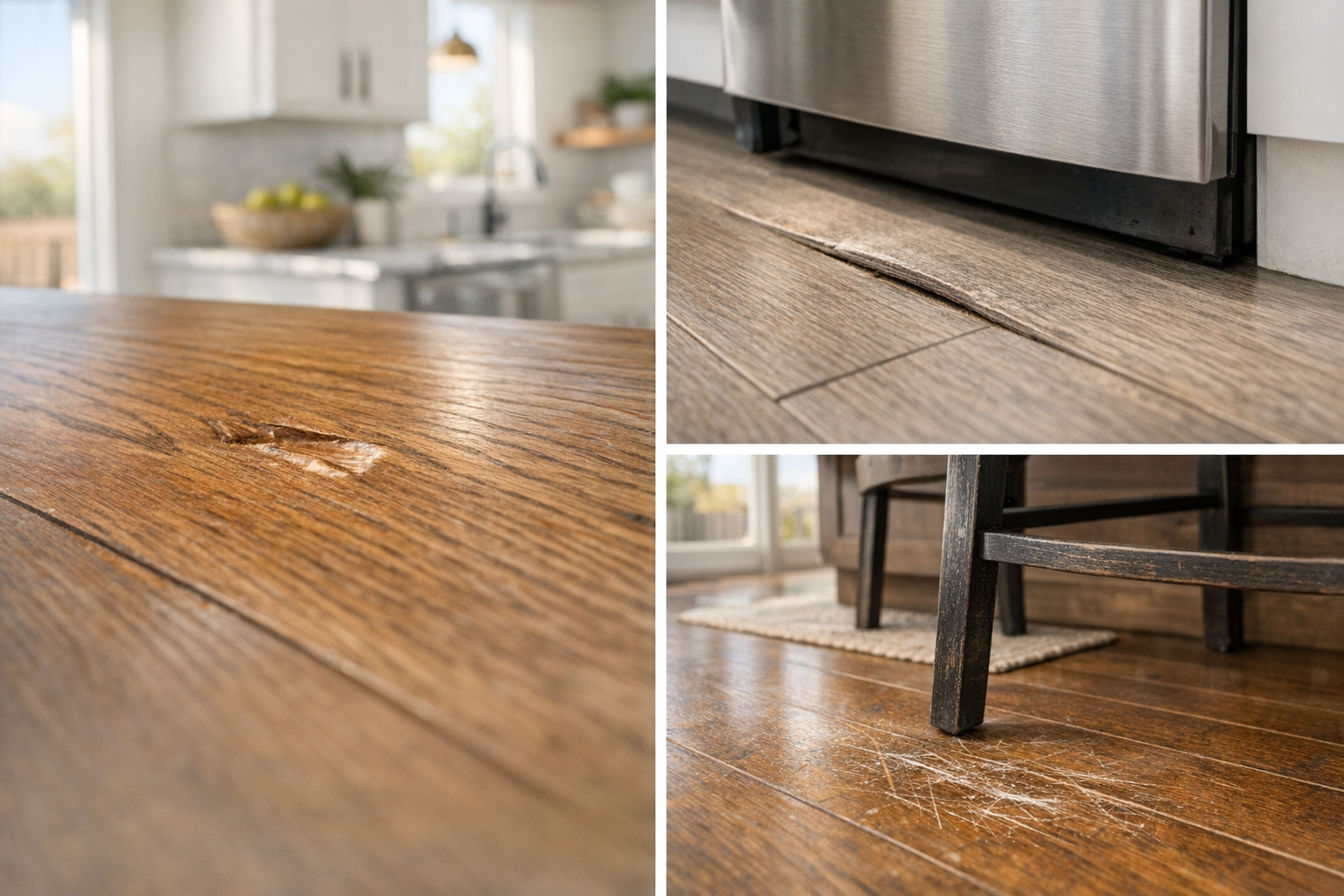
Real Denton Homeowner Scenarios We Repair Every Week (And What Usually Causes Them)
Most flooring damage isn’t dramatic—it’s the stuff you notice every time the sun hits it or every time you walk past the island. In Denton homes, we see patterns: a single impact in the kitchen that turns into a “how did we miss that?” dent, a small leak that shows up weeks later as edge-peaking, or a doorway transition that keeps cracking because the slab is doing what slabs do in North Texas.
The repair approach changes based on what caused the damage. A dent with compressed fibers can sometimes be lifted; a dent with fractured fibers usually needs fill and finish blending or a plank swap. A raised seam after water is a different animal—if the core swelled, the “fix” has to address the compromised material and the moisture source, not just push the edge down.
Dropped-object dents in kitchens
A cast-iron skillet or a full tumbler lands on oak or engineered wood, leaving a crater that looks minor until west-facing sunlight hits it. We evaluate whether the fibers are compressed (possible lift/steam technique) or fractured (needs fill and spot finish or board replacement).
Swollen seams after a leak
A refrigerator line, dishwasher seep, or dog bowl overflow wicks under floating floors; the edges rise first, and the core may be compromised even if the top looks fine. Our approach focuses on moisture source confirmation and removing only what’s necessary to stop future edge-peaking.
Chair and stool wear at islands
Repeated micro-scratches turn into a dull “traffic halo” that won’t clean off. We often recommend a localized refinish/coat strategy or plank swap plus upgraded felt/rolling-protection so the same wear pattern doesn’t reappear.
Cracked tile or lippage at transitions
North Texas slab movement can telegraph into flooring at doorways where different materials meet. We address the transition build-up and expansion gaps instead of just swapping the cracked piece.
Pet damage that’s deeper than it looks
Nail scratches through aluminum oxide finishes on prefinished floors collect dirt and turn dark. We choose repair materials that won’t reject finish and explain why some “scratch kits” make the spot shinier and more obvious.
“One board keeps moving” complaints
Often it’s not one board—it’s a pinch point, a failed adhesive pocket, or a floating floor that’s been trapped by trim. A lasting fix means correcting the underlying restriction so the floor can move without buckling.
Denton Climate + North Texas Slabs: Why Floors Fail Here (And How Repairs Are Designed to Last)
Denton floors don’t fail in a vacuum. We routinely walk into homes where the homeowner thinks the flooring “just started acting up,” but the timeline matches a humid spring, a long stretch of HVAC runtime, or a small water event that never fully dried under a floating system. In North Texas, wood movement is not theoretical—it’s measurable across seasons.
Our repair plan has to respect expansion and contraction. The fastest way to create a repeat failure is to hard-lock a repair area that needs to move with the rest of the floor. We also treat sunlight as part of the job: even the right species can look wrong if the room has faded unevenly over time. We match what your floor looks like today, in your lighting, from the sight lines you actually live with.
- Denton swings between humid spring storms and long, hot summers where HVAC runs hard; that cycling changes indoor relative humidity, and wood expands/contracts across the grain—repairs must respect expansion gaps and avoid “hard-locking” boards that need to move.
- Many homes in the area are built on slabs that move seasonally; when slab edges or interior beams shift, you’ll often see the problem first at long hallways, wide openings, or near exterior doors—our repairs include checking for pinch points where flooring is trapped and buckles under compression.
- Sunlight is a repair factor: west-facing rooms can fade boards unevenly, which means a perfect species match can still look wrong; we plan stain/tint and feathering to match the room’s current color, not the color from the original box.
- Concrete moisture matters even years later; for glue-down systems we look for signs of adhesive breakdown and alkalinity issues, because a patch that ignores moisture migration can release again and create new hollow spots.
- We explain the “why” behind simple prevention steps—like maintaining consistent thermostat settings and using entry mats—because in this climate, the best repair is the one that doesn’t get stressed by avoidable moisture and grit.
Repairs designed to last
- Expansion gaps verified so the repair area can move with the floor.
- Moisture source confirmed (even “tiny leaks” under appliances) before cosmetic work.
- Boundary lines hidden at thresholds, toe kicks, or transitions—not a visible square.
- Sheen and tint matched to current floor color under your lighting.
- Subfloor/flatness checked so joints don’t re-open in the same spot.
What “patch and run” looks like later
- A shiny picture-frame outline that stands out more than the original scratch.
- Edge-peaking returns because the core was already swollen.
- Hollow spot comes back because adhesive was never stabilized/cured correctly.
- Color match looks fine at night, wrong at 4 PM when the sun hits.
- Buckle reappears because flooring was trapped by trim or heavy cabinetry.
If you’ve had recurring buckles or squeaks in the same area, don’t assume it’s “just old flooring.” It’s often a movement or moisture pattern that can be corrected with the right approach.
Our Floor Repair Process (What We Do Differently Than a “Patch and Run” Crew)
The hardest part of floor repair isn’t cutting out the damaged board—it’s making the finished area read as “original” in real life. That means we plan the repair around light direction, traffic patterns, and where your eye naturally lands (islands, hallways, and big sliding doors are the usual culprits). We also treat your home like a remodel environment because dust and debris travel farther than people think, especially when HVAC returns are pulling air.
Document the damage the way you’ll see it
We look at the defect from standing height and from the angle where sunlight rakes across the surface. The goal is to avoid the classic “it looked fine until 3 PM” surprise—open-concept homes are unforgiving because one spot can be visible from multiple rooms.
Find the root cause before we touch finish
Leaks, threshold intrusion, pet areas, and subfloor movement all leave different clues. Fixing the symptom without fixing the cause is why many quick repairs fail fast—especially after the next humidity swing or the next appliance cycle.
Choose a method that matches the construction
Plank replacement with weave-in techniques, seam re-locking for floating floors, adhesive injection with weight curing for localized hollow spots, and finish blending that doesn’t leave a glossy halo—each floor type demands a different playbook.
Protect your home like a remodel job
We plan cut lines, staging, and cleanup to keep fine debris out of adjacent rooms and HVAC returns. A clean jobsite is part of quality—nobody wants a perfect repair and dust everywhere else.
Set honest expectations before we start
We tell you what will be invisible, what will be “hard to notice unless you know where to look,” and what can limit perfection (discontinued product, heavy sun fade, prior coatings). Clear expectations prevent frustration.
Finish with durability in mind
Cure windows matter. We schedule around the products we use so you’re not walking on soft filler or reintroducing moisture too early. It’s not about speed alone—it’s about repairs that stay put.
Want to sanity-check a repair plan? Call 469-340-0837—we’ll ask the questions that typically change the answer (water, sun exposure, floating vs glued, and where the nearest transition is).
Material-Specific Repairs (Hardwood vs Engineered vs Laminate vs LVP) — What Works, What Doesn’t
“Floor repair” means different things depending on what you have. A technique that works beautifully on solid hardwood can ruin a thin engineered veneer. A laminate chip kit can look okay in a dim hallway and look terrible in a bright kitchen. And LVP dents are usually permanent—trying to heat them out often distorts the texture so the plank stands out even more.
We approach repairs with the material’s failure mode in mind: wood fibers compress or fracture; engineered wear layers limit sanding; laminate cores swell and click-locks get compromised; LVP joints separate when the subfloor isn’t flat. When homeowners understand those differences, pricing and timelines make a lot more sense—and so does the decision between repair, targeted replacement, or a transition-based solution.
Solid hardwood
Compression dents can sometimes be lifted if the finish isn’t shattered; deep gouges often need fill plus color work. With wide-plank floors, we plan for seasonal movement so the repair doesn’t telegraph as a straight-line crack later.
Engineered wood
Wear-layer thickness determines whether sanding/feathering is safe. If the veneer is thin, plank replacement or targeted blending is often smarter than aggressive sanding that exposes the core.
Laminate
Many chip repairs fail because the core swells or the click-lock is compromised. Durable fixes are typically plank replacement—either disassembly from the nearest wall or a surgical swap when layout allows.
Luxury vinyl plank (LVP)
Dents are usually permanent; heat reshaping can distort the embossing. We replace the affected plank(s) and verify subfloor flatness so joints don’t separate again in the same spot.
Tile/stone transitions
Cracks at thresholds often originate from height differences or missing movement joints. We treat the transition as a system so the repaired area doesn’t re-crack when the slab shifts.
Discontinued materials
We look for donor boards (closets/under appliances) and plan stopping points at natural breaks. The goal is to avoid the “patched square in the middle of the room” look.
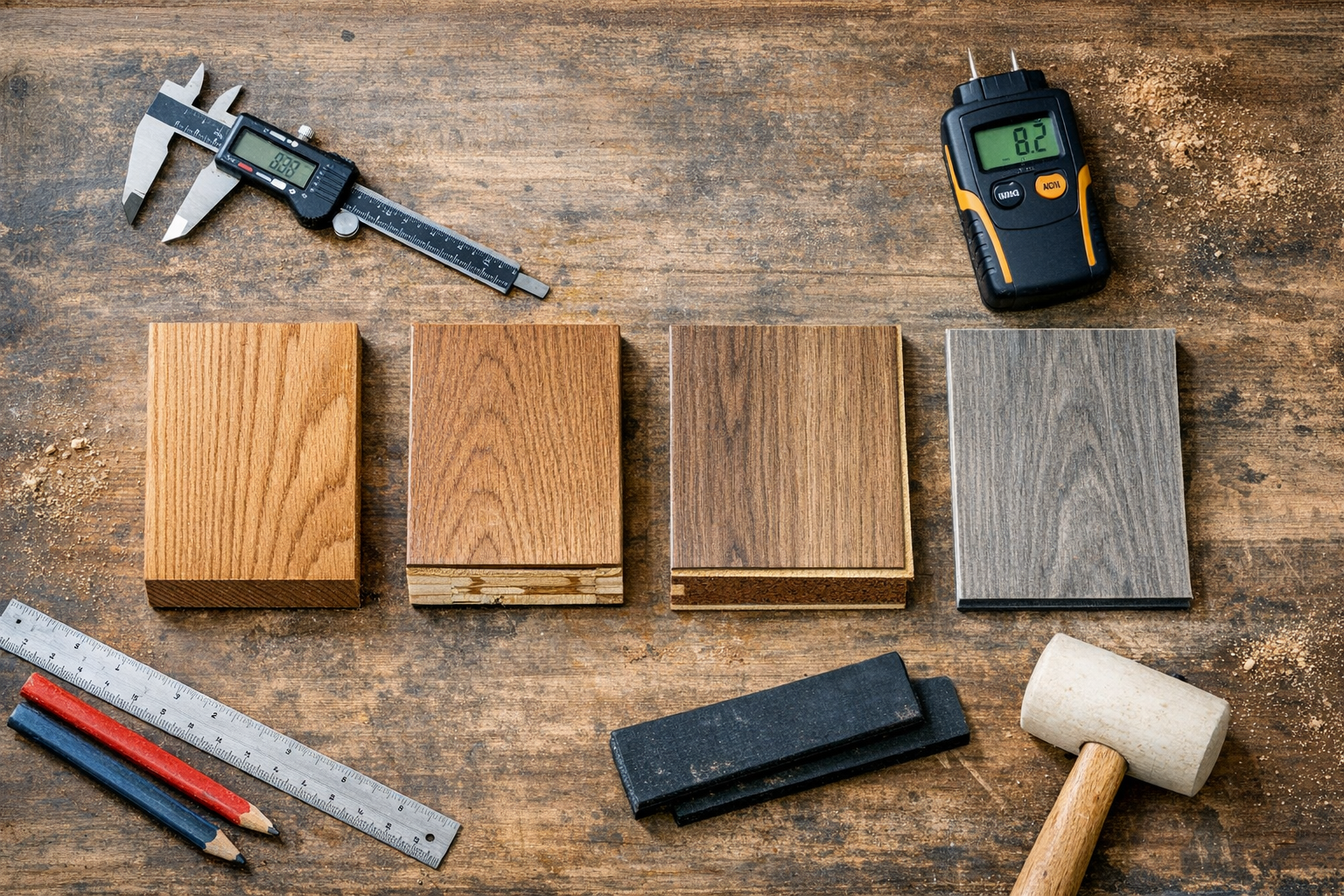
The details that matter most—wear layer thickness, locking mechanism condition, moisture indicators—are the same details that decide whether a repair lasts.
What Affects Floor Repair Pricing in Denton (And How to Think About Value)
Floor repair pricing isn’t just “per plank” or “per scratch.” In real homes, the time is often driven by access and match work. A single damaged plank in the middle of a glue-down can be slower than three near a threshold because we have to preserve surrounding edges and avoid collateral damage that turns one problem into a bigger one.
The work you don’t immediately see—material sourcing, donor board planning, custom tinting, feathering sheen so it doesn’t flash under sunlight, and allowing proper cure windows—is what creates a repair that doesn’t keep calling attention to itself. If water or slab movement is involved, durable value is almost always tied to addressing the cause. Otherwise, the “cheap fix” becomes the expensive fix after the second or third attempt.
- Scope is determined by access and layout: replacing one damaged plank in the middle of a glued-down floor can take longer than replacing three near a threshold, because we may need more careful cutout and edge preservation to avoid collateral damage.
- Matching work is a real line item: sourcing discontinued materials, pulling a donor board from a closet, custom tinting filler, and blending sheen takes time—but it’s what separates a repair you forget about from a repair that catches your eye every day.
- Moisture and subfloor conditions change the plan: if we find elevated moisture or movement, we may recommend remediation steps (drying, barrier, re-fastening, flattening) because skipping them is how buckles, hollow spots, and joint separation return.
- Timing and curing matter: adhesives, fillers, and finishes have cure windows; rushing can trap moisture or leave soft spots that dent again under normal foot traffic, so we build the schedule around durability—not just speed.
- The best value is often targeted replacement plus prevention: swapping the failed area and fixing the root cause (leak, expansion pinch, chair protection) typically costs less over time than repeating cosmetic touch-ups that don’t hold.
“We get a lot of calls that start with ‘It’s only a couple boards…’ and then we find the floor is pinched at the doorway or trapped by quarter-round. Once the floor can move again, the repair stops re-opening.”
“The stain match that looks perfect under recessed lights can read too warm in afternoon sun. We test for undertone and sheen because that’s what makes a repair ‘flash’ from across the room.”
“With laminate and LVP, the joint integrity matters more than the scratch. If the click-lock is compromised, the best-looking touch-up still fails when the seam starts to gap.”
Common DIY & “Cheap Repair” Mistakes We’re Called to Fix
We’re not anti-DIY. We’re anti-regret. The most common issue we see is when a homeowner uses a product meant to “hide” a scratch but accidentally changes the sheen or undertone—so now the repair spot catches your eye faster than the original damage. The second most common issue is locking a floor that needs movement, which is a big deal in North Texas where seasonal humidity changes are strong enough to force buckling.
If you’re deciding whether to attempt a touch-up, think about the downside: does the product add shine? Will it repel finish later? Are you filling a dent that is actually a structural issue (swollen core, delamination, or subfloor deflection)? A careful evaluation can save you from turning a small problem into a multi-board replacement.
DIY mistake patterns
- Overusing wax sticks or stain markers that don’t match undertone, creating a dark shiny stripe—especially visible in afternoon sun.
- Filling dents without stabilizing edges; filler pops, collects dirt, and becomes a bigger eyesore.
- Caulking expansion gaps or pinning floating floors with heavy items, leading to buckles when humidity rises.
- Breaking click-lock joints during disassembly; new gaps appear even after “replacement.”
- Ignoring moisture evidence (musty smell, swollen baseboards, dark underside), so cosmetic fixes fail quickly.
How we prevent repeat failures
- Match undertone and sheen—so the fix doesn’t “flash” from across the room.
- Prep, stabilize, and seal so repairs stay clean in traffic paths.
- Confirm the floor can move; correct pinch points at thresholds and trim.
- Plan safe entry points for floating floors to preserve the locking system.
- Validate moisture conditions so the repair isn’t fighting an ongoing source.
If you already tried a kit and it looks worse, don’t feel stuck—many times we can correct the sheen and re-blend, but the sooner we see it, the easier it is.
Local Trust Signals & Verifications (So You Can Hire With Confidence)
When you’re inviting a crew into your home, the “is this a real company?” question matters. We recommend cross-checking a contractor across multiple third-party sources—especially when you see similar names online. Consistency across listings (company name, location, service focus, and longevity) is one of the simplest ways to reduce risk before you ever schedule an appointment.
JBN Flooring / The JBN Group can be verified through established directories and associations. If you’re collecting bids, ask each contractor for verifiable profiles—reputable companies don’t hesitate to share them because transparency prevents misunderstandings later. You can also follow ongoing updates and local engagement through Facebook to get a feel for communication and workmanship standards.
Prefer to start at the source? Visit JBN Flooring or request an appointment via Contact Us.
FAQ: Floor Repair in Denton, TX (Real Questions We Hear in Homes)
These are the questions that come up at kitchen islands, in long hallways, and right by exterior doors—where Denton homes tend to show wear first. If your situation sounds similar, we can usually tell you what direction the repair will go after a short call and a couple of well-lit photos.
“Can you fix a dent in hardwood without replacing the board?”
Sometimes—if it’s compression and the finish isn’t shattered, a lift/level approach may work. If fibers are broken or the dent is sharp-edged, a fill-and-blend or board replacement is more reliable and less likely to fail in traffic.
“How do you match stain when my floor has faded?”
We match what’s on your floor today under your lighting, often testing tint in a discreet area. Sun fade and oxidization mean an “original stain name” is rarely a perfect match years later—especially in west-facing Denton rooms.
“Do repairs always look invisible?”
Many do, but we set honest expectations. Heavy texture, hand-scraped finishes, and dramatic sun variation can make perfect invisibility unrealistic. Our goal is a repair that doesn’t grab your attention in normal living conditions.
“What if my laminate or LVP is discontinued?”
We look for donor boards (closets, under appliances), compatible alternatives, or strategic transition points. The plan depends on where the damage is and how much of the floor needs to be opened to reach it without compromising joints.
“How soon can I walk on the repaired area?”
It depends on the method and products used. Some repairs are walkable the same day, while adhesive or finish work may require a defined cure window. We’ll give you clear do’s/don’ts so the repair doesn’t dent or shift early.
“What should I send in photos for the most accurate advice?”
One close-up, one photo from standing height, and one wider shot showing the nearest threshold/transition. If water was involved, include the appliance or door area and any baseboard swelling—those details often change the repair plan.
For scheduling and next steps, use Get Your Quote Today or call 469-340-0837.
Ready to Make That Damaged Spot Disappear (or at Least Stop Getting Worse)?
Call JBN Flooring to talk through what happened, what material you have, and the most durable fix for Denton’s climate and typical slab movement. Prefer online? Request a quote and we’ll guide you on photos to send and what to expect next.
Want to explore services and credentials first? Visit jbnflooring.com.