
Flooring Argyle TX Homeowners Actually Brag Abou Do not change the title
JBN Flooring installs floors that look great on day one—and still look great after North Texas summers, muddy cleats, dog nails, and the occasional kitchen spill. If you want honest guidance (not showroom upsells), tight prep work, and a finish you’re proud to show off, you’re in the right place.Want to vet the company first? Start with JBN Flooring and then compare the scope details—not just the bottom-line number.

What Argyle homeowners actually need from a flooring contractor (not what the brochure says)
If your home is on a concrete slab (most are around Argyle), the “pretty part” of the project starts long before the first plank clicks together. The floors people brag about are the ones that stay quiet, stay flat, and keep their seams and edges looking intentional a year later.
Here’s what we see in the field: a floor can look flawless in a showroom and still fail in a real Argyle living room if the slab is moisture-active or out of tolerance. North Texas also puts floors on a rollercoaster—hot, dry weeks, sudden storms, and HVAC cycles that push expansion and contraction. Our job is to steer you toward the right material and the right installation method so the floor doesn’t gap, cup, or “edge-peak” after the first brutal summer.
We also plan the human part: mud tracked in from the driveway, pets that corner hard, rolling desk chairs, and remodel logistics when you’re living in the home. If you’re ready to stop guessing, contact our team to schedule your free estimate via our Argyle flooring quote form.
What “brag-worthy” usually means in real houses
- No hollow spots in traffic lanes and no clicking when the house cools down at night.
- Clean transitions at bedrooms, baths, and around islands—no random T-molds where they don’t belong.
- Wear you don’t notice: micro-scratches are inevitable; the right texture and sheen make them disappear in daylight.
- A plan for living through it: sequencing, dust control expectations, and “no-surprise” dry times.
If you’re still comparing, start with the questions that reveal quality: moisture testing method, leveling tolerances, and how transitions are planned on long runs.
Slab reality (the part nobody frames)
We don’t treat a slab like “good enough if it’s hard.” We look for dips that make planks flex, humps that cause rocking, and old adhesive that keeps leveling compound from bonding—because those show up later as noise and separation.If you’ve ever heard random pops in a hallway, it’s often a flatness problem, not a “bad product.”
Sun + HVAC = movement pressure
South and west rooms in Argyle can bake in the afternoon. That heat, followed by cooled nights, drives expansion cycles. We plan expansion gaps, transitions, and material choices to handle the swing without telegraphing seams.Long, uninterrupted runs are where corner-cut installs start failing first.
Life-proof finishes, not “showroom-proof”
Dust and grit are the real enemies. A matte, textured surface often looks cleaner longer than a glossy one—and a tighter bevel helps keep debris from collecting in seams.We’ll have you view samples in your own daylight so tones don’t shift unexpectedly.
Snippet-ready takeaway
In Argyle, most “flooring failures” aren’t the brand—they’re the prep: slab moisture, flatness, acclimation, and transitions around sun-soaked rooms and long hallways.
Snippet-ready local intro: why floors fail in Argyle (and how we prevent it)
A common Argyle scenario: a homeowner chooses a “waterproof” floating floor, skips acclimation, and installs over a slab that wasn’t moisture tested. Months later, you see end-joint separation, hollow-sounding spots, or peaking near sunny windows—problems that are more about prep and site conditions than the brand.
We treat every project like it has a story underneath it: slab moisture, dips and humps, prior adhesive residue, cracked concrete, and door-to-door height changes. Fixing those details is what keeps the floor quiet, stable, and visually clean over time.
We plan for the specific stress points we see locally: south- and west-facing rooms with heavy afternoon sun, long hallways where expansion gaps get forgotten, and kitchen-to-living transitions where most DIY and low-bid installs start to fail first.
If you want a floor you can brag about, the “unseen” work—moisture testing, leveling, underlayment selection, and correct transitions—is what makes the finished surface look expensive and stay that way. If you’re ready, contact JBN Flooring for a site-specific quote that accounts for prep instead of pretending it doesn’t exist.
Choosing the right flooring in Argyle TX: LVP vs engineered hardwood vs tile (real-world comparisons)
The “best floor” isn’t a single product—it’s the one that matches your traffic, your sunlight, and your slab. We’ll walk you through the tradeoffs the way we do on site: what fails first, what stays quiet, what shows scratches, and what’s easiest to live with when life gets messy.
What we recommend most often (and why)
- LVP is usually the best fit for busy households because it handles spills and pet accidents without panic. But core rigidity and wear layer thickness matter when slabs aren’t perfectly flat or when window-driven heat swings are aggressive.
- Engineered hardwood is the “brag-worthy” upgrade for authentic wood and resale appeal. In Argyle, it shines in bedrooms, offices, and formal spaces—while kitchens and entries need smarter protection and expectations.
- Tile is still the king for wet zones and high-heat rooms. The win is value-per-year, but only if the substrate is prepped correctly (uncoupling where needed, proper thinset, and grout that won’t become a permanent stain story).
Want an opinion that’s tailored to your home? Speak with our team today and we’ll explain which material makes sense for your rooms and sunlight patterns—then build the quote around the prep your slab actually needs.
How to decide in 10 minutes (the homeowner test)
- Do you have strong afternoon sun? Prioritize stability under heat, plan transitions, and avoid finishes that highlight glare and dust.
- Are you on a slab with unknown moisture? Don’t pick a product first—pick a moisture plan first.
- Do you want low-maintenance living? Choose a finish that forgives grit, and build an entry strategy (mats, felt pads, and chair protection).
- Are you remodeling while living there? Floating systems may phase easier, but only if flatness and transitions are handled correctly.
We’ll also help you avoid lighting surprises—some tones that look “neutral” under showroom LEDs can read blue or orange in bright North Texas daylight.
Installation decisions that separate a quiet, flat floor from a problem floor
Moisture testing on slab is non-negotiable in our climate. We’ve seen floors that looked fine for a season and then started to cup or release because a slab was still transmitting moisture; the fix is much more expensive than doing the test and mitigation up front.
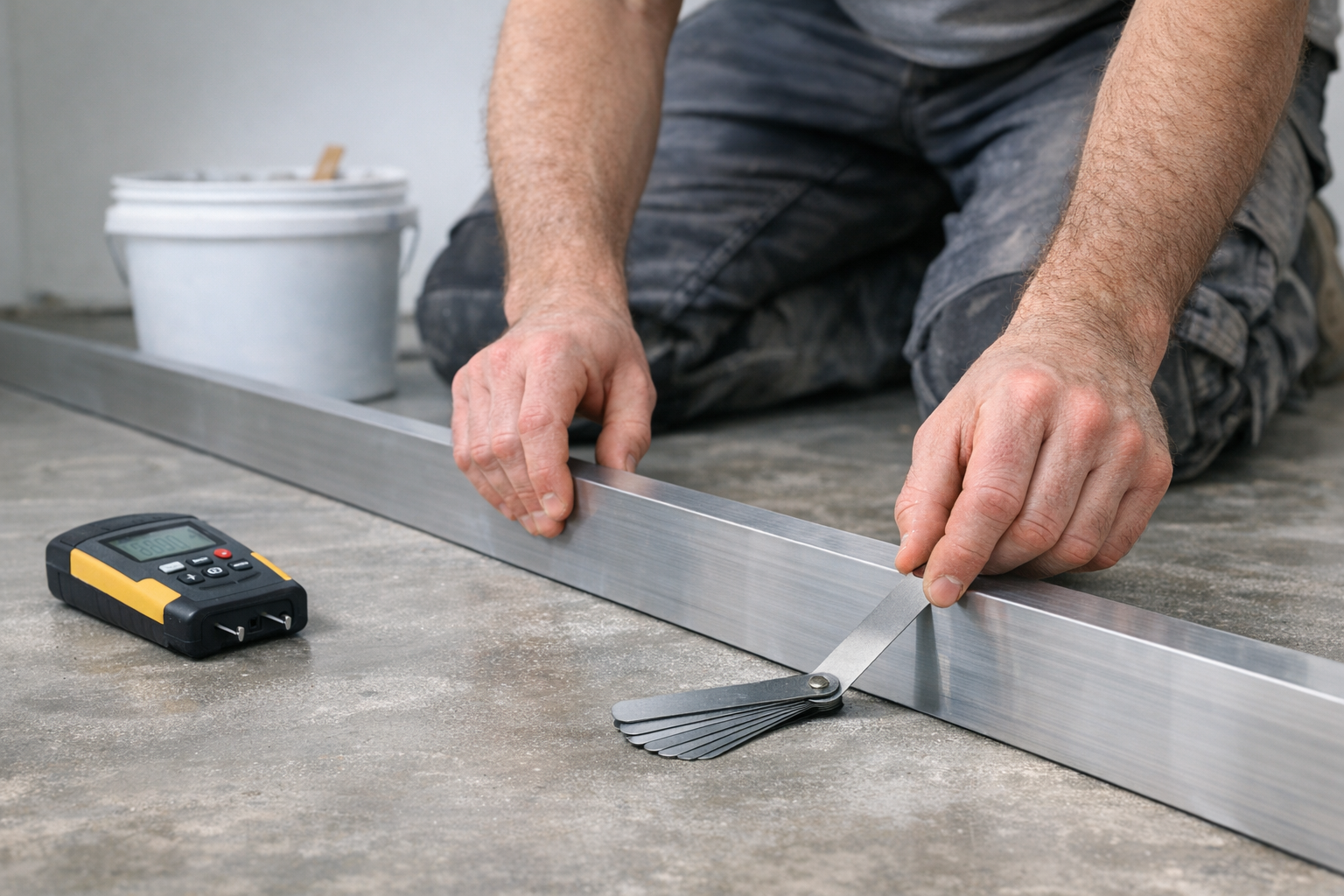
Flatness is what you feel every day. If a slab has dips, a rigid plank can bridge and eventually click, flex, or separate; if it has humps, you get rocking and noisy spots. We level to the tolerances required for the product, not the tolerances that are “good enough to walk on.”
Transitions and expansion gaps are where installers cut corners and homeowners pay later. We plan transitions at doorways, long runs, and around kitchen islands so the floor has room to move without telegraphing gaps or buckling.
Stairs are their own discipline. We match nosing profiles, control squeaks, and choose adhesives/fasteners that hold up to daily impact—because stair failures aren’t just ugly, they’re a safety issue.
If you want a quote that calls out prep and transitions clearly (instead of hiding them), request a free consultation and we’ll build a plan around your slab, your sun exposure, and your timeline.
1) Measure & test
We check flatness in multiple directions and moisture risk before we pick the system. This prevents “mystery pops” and seam stress later.2) Prep the slab
Leveling and bonding are where long-term performance is decided. This is also where low bids usually quietly cut corners.3) Install + detail
We keep runs straight, pattern intentional, and cuts clean around cabinets and islands so the finish reads premium up close.4) Protect the result
We’ll show you how to control grit at entries and avoid cleaner residues that make floors look dull faster.Quick conversion check
If an installer can’t clearly explain moisture testing, leveling tolerances, and where transitions will go, you’re not buying a “floor”—you’re buying a roll of the dice.
What affects flooring cost in Argyle (and how to spot quotes that will become expensive later)
Most homeowners assume the product is the big cost driver. In real Argyle projects, the biggest swing is usually the prep—because slabs, old glue, and flatness issues don’t care what brand is printed on the box.
Prep is the real “insurance policy”
Demo complexity, glue removal, leveling, crack isolation, and moisture mitigation add cost, but those line items are often what keep the floor from failing two summers from now. If a quote is dramatically lower, it usually means prep is being skipped or minimized to the point that the warranty becomes a paperwork exercise.We’d rather show you the ugly truth up front than sell you a “perfect” number that turns into change orders.
Layout drives labor more than people expect
Large continuous areas with lots of cabinets, angled walls, islands, and multiple room transitions take more time than a square open room. We price based on what your home actually requires—especially around kitchens and long hallways where precision prevents future movement issues.If your quote is “square footage math only,” expect the details to get rushed.
Material upgrades that are worth it here
Wear layer thickness, core rigidity, finish type, and stability under sun exposure matter in North Texas. We’ll tell you which upgrades buy you durability—and which are mostly marketing.Low bids usually hide one of three shortcuts
Prep gets skipped, underlayment/adhesive systems get downgraded, or acclimation/cure times get rushed. Those don’t show on day one—they show when you hear pops, see edge lift, or notice stains you can’t clean.What “expensive later” looks like
Replacing failed sections means moving furniture twice, matching lots/dye lots, and redoing transitions. Doing it right the first time is almost always the cheaper path.If you want us to review your space and explain where the budget should go (and where it shouldn’t), contact our team today through JBN Flooring’s contact page and we’ll build a scope you can compare apples-to-apples.
Longevity in North Texas: sun, HVAC swings, slab movement, and what we do about it
In Argyle homes with big windows, UV and radiant heat can stress floors and fade finishes over time. We’ll talk through window coverings, rugs, and product choices that resist color shift and minimize heat-related movement—especially in west-facing rooms that get hammered in late afternoon.
HVAC cycles create indoor humidity swings that wood feels immediately. We give practical guidance on target indoor humidity ranges and what symptoms mean (seasonal gapping vs. real installation issues), so you know what’s normal and what’s not.
Concrete slabs can transmit moisture for years depending on site drainage and how the home was built. Where risk is higher, we recommend appropriate vapor barriers or moisture systems so the floor isn’t acting like a lid on a damp surface.
We also help homeowners avoid maintenance traps. Some “floor cleaners” leave residues that attract dirt and make a floor look dull faster; we recommend routines that keep matte finishes looking clean without creating a sticky film. If you want a plan tailored to your rooms and sunlight, call 469-340-0837 and we’ll walk you through options.

Maintenance that actually works in Argyle
Our best “looks-new-longer” tip is boring on purpose: keep grit out. A serious entry mat plan and felt pads prevent the sandpaper effect that makes homeowners think their finish “failed.”
If your floor looks dull a month after cleaning, it’s often residue buildup—fixable with the right routine.
Common Argyle homeowner mistakes we see (and how to avoid them)
Most mistakes aren’t dramatic—they’re small assumptions that snowball. We’re sharing these because we’ve been called in after the fact, when the “cheap” decision became the expensive one.
“Waterproof” doesn’t mean “problem-proof”
Waterproof covers surface spills. It doesn’t cancel out slab moisture transmission, uneven subfloors, or expansion pressure. If you want a floating system, the prep and moisture plan matter more than the word on the box.A common symptom: peaking near sunny windows because the floor is stressed and can’t move where it needs to.
Showroom lighting lies (especially in North Texas daylight)
In bright Argyle daylight, some grays read blue and some warm neutrals read orange—especially across large, open rooms. We recommend viewing samples in your actual room morning, afternoon, and evening so you don’t end up “stuck” with a tone you didn’t expect.If you’re unsure, we’ll help you pick a color that stays stable across lighting changes.
Entry protection is the cheapest durability upgrade
Mats, grit control, and felt pads can double the life of the finish in real households. It’s not glamorous, but it’s why some floors still look great after years of kids, dogs, and backyard traffic.We’ll tell you exactly where we see wear first: the garage entry, kitchen work triangle, and hallway pinch points.
Not planning height changes during remodels
Switching materials can create awkward step-ups at exterior doors, toe-kick gaps at cabinets, or trim that no longer covers edges. We catch these issues before install and recommend solutions that look intentional, not improvised.This is also where “we’ll figure it out later” turns into delays and extra cost.
If you’re mid-decision and want a second set of eyes, contact our team today to schedule your free estimate. We’ll outline practical tradeoffs, not sales talk—then you can decide with confidence.
Local authority & trust signals (citations homeowners can verify)
We make it easy to verify the business behind the work. If you’re comparing contractors, use third-party profiles and memberships to confirm legitimacy, history, and accountability before you sign anything.
Citations you can review include the BBB – Better Business Bureau profile and the Directorii – Verified Contractor profile for additional third-party trust signals.
Industry and local associations matter when problems arise and you need standards-based guidance. You can also see affiliations like NARI – National Association of the Remodeling Industry, NKBA, and the Dallas Builders Association.
For community and review touchpoints, you can reference The Good Contractors List, the Lake Cities Chamber of Commerce, the The JBN Group Google share link, and Facebook.
When you’re ready for a straightforward conversation about your home (not a sales pitch), call 469-340-0837 or request a quote through our contact page.
How to use these citations when comparing bids
- Confirm the business identity and history match what’s on the proposal.
- Ask who is accountable for moisture mitigation and leveling scope.
- Compare “prep” as a real deliverable, not a vague line item.
- Make sure your installer can explain transitions and expansion strategy for long runs and sunny rooms.
Transparent next step
Send photos of your existing floors, transitions, and the sunniest rooms. We’ll tell you what we’re looking for and what it means—before anyone starts tearing anything out.Use: Get Your Quote Today or call 469-340-0837.
Note: This page focuses on flooring installs in Argyle, TX. For broader company info and services, visit JBN Flooring.
Flooring Argyle TX FAQs (answered like we’re standing in your living room)
These are the questions we hear when homeowners are trying to balance schedule, mess, pets, and the fear of choosing the “wrong” material. We’ll give you the real answer—the one that depends on prep, cure times, and how your home actually behaves.
How long does a typical flooring project take?
Most installs are fast once prep is complete, but the schedule is determined by demo, leveling cure times, and whether you’re doing stairs or multiple materials. The timeline we give you is based on the realities of dry times—not wishful thinking—so the finish lasts.Do I need to leave the house during installation?
Not always. For occupied homes, we can often phase the work room-by-room, but you should expect noise, foot traffic restrictions, and occasional “no kitchen” windows when leveling or installing around cabinets.What’s the best flooring for pets in Argyle?
For large dogs and high traffic, we often recommend high-quality LVP with a durable wear layer and a texture that hides micro-scratches, plus entry protection to control grit. If you want real wood, engineered hardwood can work with the right finish expectations and routine.Can you install over existing tile or hardwood?
Sometimes, but only when height, flatness, and moisture conditions cooperate. We’ll evaluate transitions, door clearances, and whether the existing surface is stable enough to avoid creating a future hollow-sounding or shifting floor.Have a specific scenario—like a sunroom that bakes in July, a long hallway run, or a slab with old glue? Contact our team today and we’ll talk through what usually works in Argyle homes and what tends to fail.