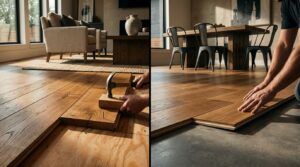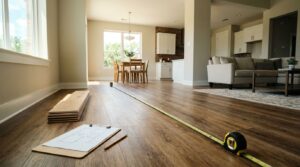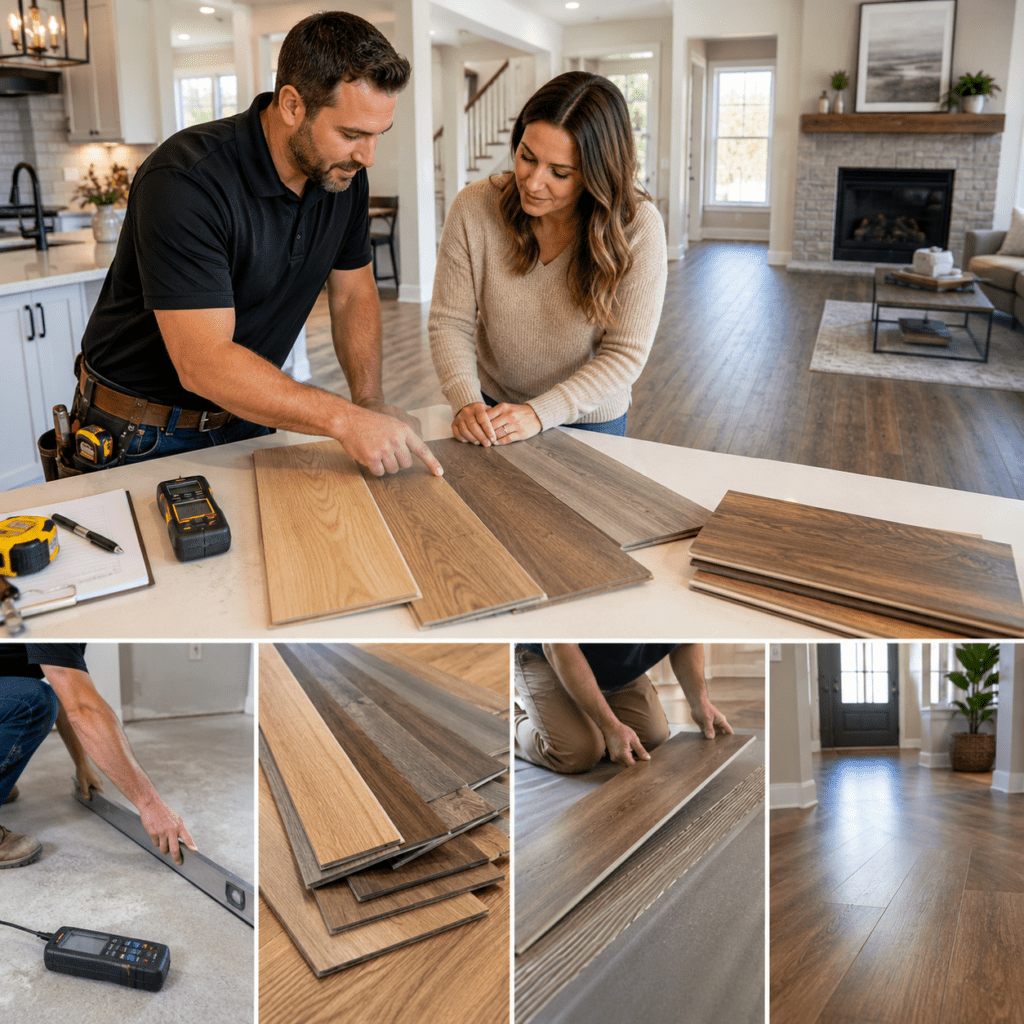
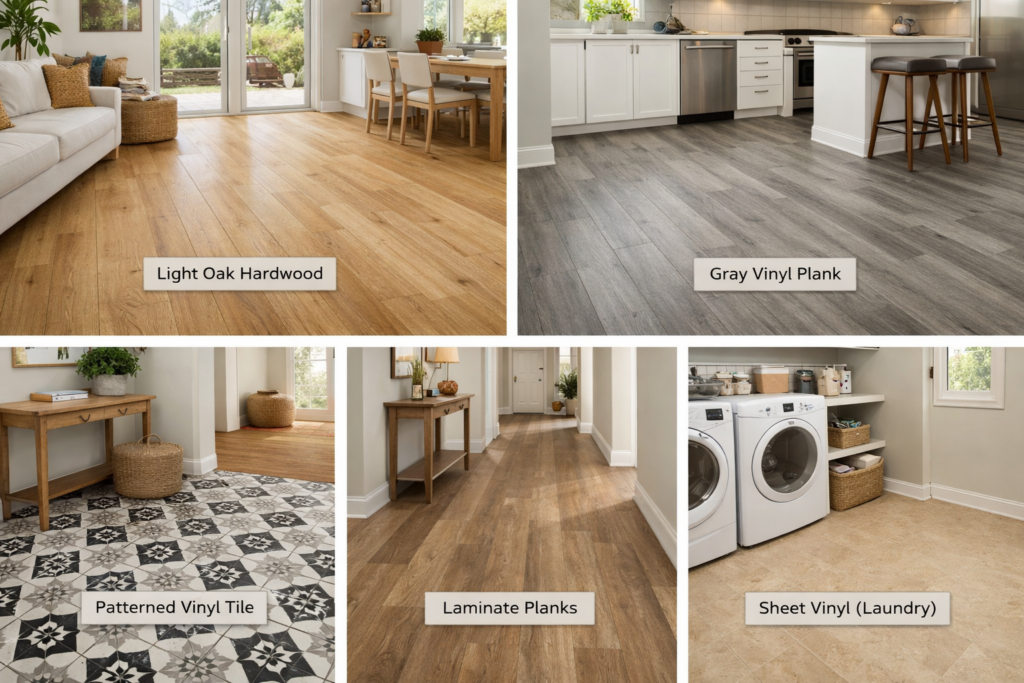
Flooring Materials and Product Types: A Practical Guide to Choosing the Right Floor
Understand the most common floor surfaces—laminate, hardwood, engineered wood, vinyl (LVP/LVT), sheet vinyl, waterproof, and click-lock systems—so you can match performance, price, and style to your space.
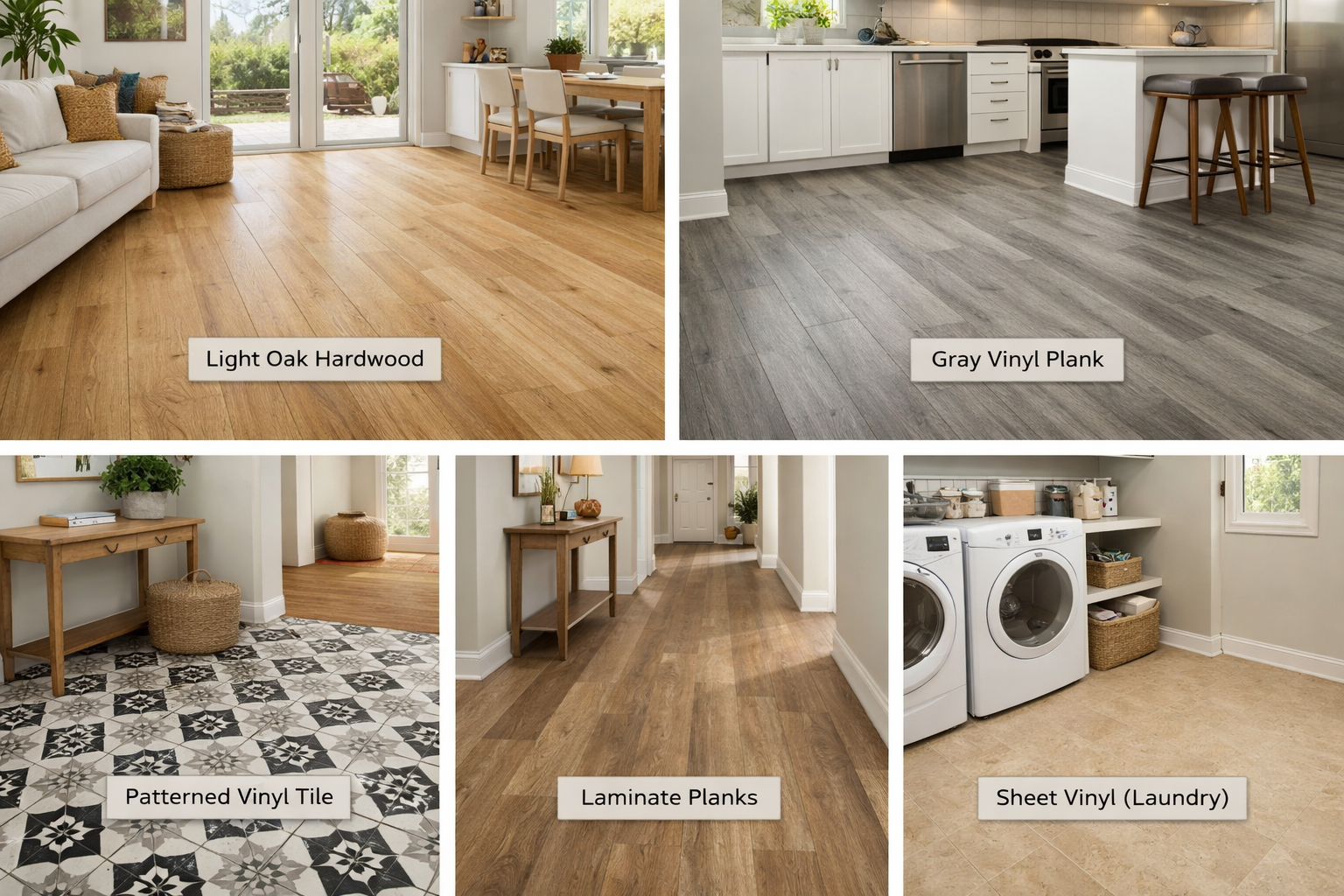
What you’ll learn
- How to evaluate flooring materials vs. product types
- When laminate flooring shines—and when it doesn’t
- How solid hardwood differs from engineered hardwood
- How to compare vinyl construction, wear layers, and cores
- LVP vs LVT: format, design, and performance considerations
- Waterproof vs water-resistant: how to read the fine print
- Click-lock systems and what “floating floor” really means
- Sheet vinyl: fewer seams for wet-prone areas
Shopping for a new floor can feel oddly complicated: two products can look nearly identical online, yet behave very differently once they’re installed. That’s because what matters isn’t only the “surface look”—it’s the full flooring system underneath: the wear layer, the core, the backing, the edge profile, and the installation method.
This guide breaks down today’s most common flooring materials and product types in plain language, with practical “best use” guidance for real homes: pets, kids, seasonal humidity, wet entryways, busy kitchens, and rentals.
If you remember one thing, make it this: choose the floor for the room’s demands first (moisture, traffic, sunlight), then refine by style and budget. That approach prevents the most common regret—buying a beautiful product that’s wrong for the space.
Flooring Materials 101: How to Think About Floor Surfaces
Before comparing laminate vs vinyl or engineered vs solid hardwood, it helps to separate two terms that get mixed together in showrooms and search results:
Material
What the floor is made from (wood, vinyl/PVC, composite core, etc.). Material heavily influences moisture response, denting, and long-term repair options.
Product type
How the material is packaged/sold (planks, tiles, sheet goods) and installed (nail-down, glue-down, click-lock floating).
For example, vinyl can be sold as LVP (planks), LVT (tiles), or sheet vinyl (rolled goods). Wood can be sold as solid hardwood or engineered hardwood. The “type” changes the install, the seam layout, and the repair strategy—even if the top visual is similar.
Start with the room’s non-negotiables
Style matters, but performance narrows the field faster. When you define the conditions up front, you’ll immediately eliminate products that don’t belong in the space.
- Moisture exposure: bathrooms, laundry rooms, mudrooms, and kitchens need better spill tolerance than a guest bedroom.
- Foot traffic: hallways and open-plan living zones can see 2–3× the daily wear of low-use rooms.
- Pets: nails + sand/dirt tracked in = scratch risk; accidents = moisture risk; zoomies = traction risk.
- Sunlight: UV exposure can fade finishes and visuals, especially in bright rooms with big windows.
- Sound: condos and upstairs rooms benefit from better acoustic underlayment and stable joints.
Think in “layers,” not just looks
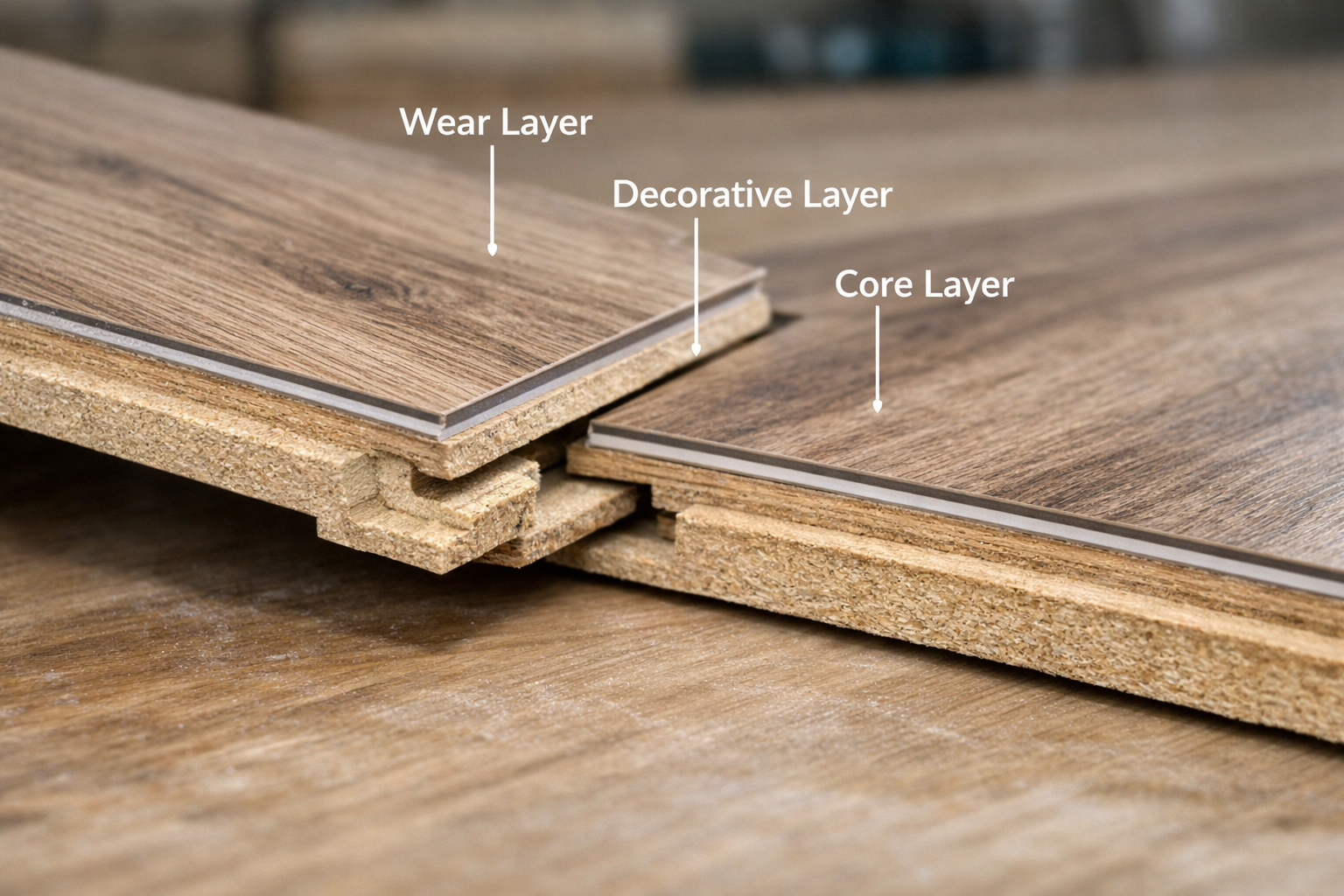
Most modern floors (except solid wood and some tile/stone) are engineered in layers. Knowing what each layer does helps you compare products that look alike but perform differently:
- Wear layer / finish: the protective top surface that resists scratches, stains, and scuffs.
- Design layer (if applicable): the image/visual layer (common in laminate and vinyl).
- Core: the structural layer that affects dent resistance, water response, and stability.
- Backing/underlayment: can add comfort, reduce sound, and influence how “solid” the floor feels.
- Edge/joint profile: the click mechanism or tongue-and-groove design that determines tightness and seam behavior.
Practical rule: If a product spec sheet only talks about the “look” and the “color,” but doesn’t clearly state wear layer (for vinyl), core type, or installation requirements, treat it as a red flag. Flooring is a system, not a photo.
Plan for real-life maintenance (and repairs)
Maintenance isn’t just “how do I clean it?”—it’s also “what happens when something goes wrong?” Ask yourself:
- Can you replace a single plank/tile if it’s damaged?
- Can the floor be refinished (common for hardwood, limited for engineered, not for most vinyl/laminate)?
- How does the floor handle chairs, rolling toys, and entry grit?
- Are you comfortable with area rugs and furniture pads as part of the plan?
Laminate Flooring: High-Style Looks with a Tough Wear Layer
Laminate has come a long way from the shiny, repetitive planks many homeowners remember. Modern laminate can deliver a surprisingly realistic wood look, strong scratch resistance, and quick installation—often at a cost that’s easier to justify for large areas or rentals.
What laminate is (and how it’s built)
Laminate flooring typically uses a photographic design layer (wood or stone visuals) under a clear wear layer, bonded to a dense core (often fiberboard) with a balancing layer beneath. That layered construction is why laminate can look consistent and install efficiently.
Why laminate is popular
- Great visuals for the price: If you want the look of oak, maple, or stone without the cost of the real material, laminate offers strong value.
- Scratch and stain resistance: Many laminates perform well in busy spaces, especially compared with softer wood species.
- Fast installs: Laminate planks commonly use click-lock joints as a floating floor, reducing adhesive use and speeding up projects.
- Consistency: Color and pattern stay uniform—helpful when you want a controlled, contemporary aesthetic.
Where laminate can disappoint
The main caution is moisture. Even products marketed as “water-resistant” can swell at seams if water sits too long—especially if the core is vulnerable and edge sealing is limited.
- Standing water risk: pet accidents, dishwasher leaks, wet boots, and mopping mistakes are the common culprits.
- Seam sensitivity: the joint is often the weak point; once edges swell, the damage is difficult to reverse.
- Refinishing limitations: unlike hardwood, laminate generally cannot be sanded and refinished to “reset” wear.
Confirm the moisture warranty terms (how many hours against topical spills), the joint/edge sealing features, and whether the product requires a specific underlayment. If the kitchen is a must, prioritize products explicitly designed for that kind of spill exposure.
Best rooms for laminate
Laminate is typically a strong match for living rooms, bedrooms, hallways, offices, and rentals—especially when you want durability, speed, and style at a practical cost.
Hardwood Flooring: Solid Wood Beauty with Long-Term Value
Hardwood is the benchmark for timeless appeal. It’s real wood—warm, natural, and capable of aging gracefully when cared for properly. The biggest long-term advantage is that many solid hardwood floors can be refinished multiple times, which can stretch the lifespan far beyond most other surfaces.
What solid hardwood is
Solid hardwood flooring is milled from a single piece of wood. That means the same material runs from top to bottom, so sanding and refinishing can remove surface damage and renew the finish (within practical limits).
Where hardwood performs best
Hardwood is best suited to low- to moderate-moisture spaces where humidity is relatively controlled: living rooms, dining rooms, bedrooms, and offices. In these spaces, hardwood offers a premium feel and a long runway for upkeep.
Performance depends on species and finish
Not all hardwoods wear the same. Species hardness affects denting, while finish type affects scratch visibility and stain resistance. Two practical considerations:
- Dents vs scratches: harder species reduce denting, but surface scratches can still occur depending on finish and debris tracked in.
- Sheen level: matte and satin finishes can hide small wear better than high-gloss, especially in bright rooms.
Installation realities (and why acclimation matters)
Solid hardwood is commonly installed with nails or staples. It also needs a solid plan for acclimation—allowing wood to adjust to the home’s humidity before installation. Skipping acclimation can lead to issues like gaps, cupping, or seasonal movement that surprises homeowners later.
Solid hardwood rewards patience: the best-looking installations often come from careful subfloor prep and acclimation—not rushing to get boards down.
If you want a floor that can be renewed over time and you’re comfortable managing humidity and using rugs/pads where needed, solid hardwood is a long-term investment that can pay back in durability and resale appeal.
Engineered Hardwood Flooring: Real Wood Top Layer with Added Stability
Engineered hardwood is often misunderstood as “fake wood,” but it’s actually a smart construction approach: a real wood surface (veneer) bonded to a layered core. The goal is improved dimensional stability—meaning the floor is less likely to expand and contract dramatically with seasonal changes.
How engineered hardwood is built
Engineered hardwood flooring pairs a real wood veneer with a multi-layer core (often plywood-like layers). This structure can help engineered floors resist movement better than many solid products, especially in climates with noticeable humidity swings.
Why it’s a practical choice in more situations
- Stability: helpful for condos, homes with big seasonal swings, and certain below-grade installations where appropriate.
- Installation flexibility: engineered wood can be installed as glue-down, nail-down, or in some cases as a click-lock floating system.
- Modern design options: wide planks, matte finishes, and contemporary stains are common in engineered lines.
Veneer thickness matters more than many people realize
Engineered hardwood isn’t one category with one lifespan—its durability is tied to the thickness of the wear layer (the real wood veneer). Thicker veneers generally allow more future refinishing; thinner veneers emphasize stability and cost efficiency but limit how much sanding is possible later.
| What to compare | Why it matters | What to ask in-store |
|---|---|---|
| Veneer / wear layer thickness | Determines if (and how many times) the floor can be refinished. | “What’s the veneer thickness in mm, and is it rated for refinishing?” |
| Core construction | Affects stability, fastener holding, and overall feel underfoot. | “Is the core multi-ply, HDF, or another structure?” |
| Installation method | Floating, glue-down, or nail-down changes sound, repair strategy, and subfloor needs. | “Which installs are approved by the manufacturer warranty?” |
If you want authentic wood character but need more installation options—or you’re worried about seasonal movement—engineered hardwood is often the “best of both worlds,” as long as you choose a construction that matches your expectations for longevity.
Vinyl Flooring (Resilient Flooring): Durable, Comfortable, and Versatile
Vinyl flooring sits in the “resilient flooring” family—meaning it has a bit of give underfoot, tends to be quieter than hard surfaces, and is generally well-suited for busy households. The big headline is water resistance: many vinyl products handle daily spills and damp spaces more confidently than wood-based floors.
Why vinyl is everywhere right now
- Water resistance: a strong option for kitchens, baths (product-dependent), entryways, and basements.
- Comfort: typically softer underfoot than tile or stone.
- Design range: wood looks, stone looks, patterns, and textures are widely available.
- Installation flexibility: click-lock floating floors and glue-down systems exist across price points.
Not all vinyl is created equal: what to compare
Vinyl varies widely by construction. Two products may both be called “luxury vinyl,” yet differ significantly in dent resistance, scratch performance, and how well joints stay tight.
- Wear layer thickness: often expressed in mil; thicker wear layers can improve long-term scuff/scratch tolerance.
- Core type and rigidity: the core influences stability, denting, and how forgiving the product is over minor subfloor imperfections.
- Texture/embossing: adds realism and can affect traction (especially important for wet-prone spaces).
- Backing/attached pad: can improve comfort and sound control, but doesn’t replace the need for a flat subfloor.
- Temperature limits: some products have constraints for sunrooms or areas with large temperature swings.
When comparing vinyl, treat the spec sheet like a “performance label.” The visual layer sells the floor; the wear layer and core determine whether you’ll still love it in five years.
Glue-down vs click-lock: how to choose
Vinyl can be installed two common ways, and the right choice depends on your subfloor, timeline, and repair goals:
Click-lock (floating)
Faster installs and easier plank replacement in some cases, but needs a flatter subfloor to prevent movement, noise, or joint stress.
Glue-down
Can feel more “locked-in” with less movement, often preferred in certain commercial/light-commercial settings, but repairs can be more involved.
Because vinyl quality ranges from budget to premium, check warranties carefully and look for a rating that matches your use (heavy residential vs light commercial). If your home is busy, those categories matter more than marketing terms.
Luxury Vinyl Plank (LVP) vs Luxury Vinyl Tile (LVT): What’s the Difference?
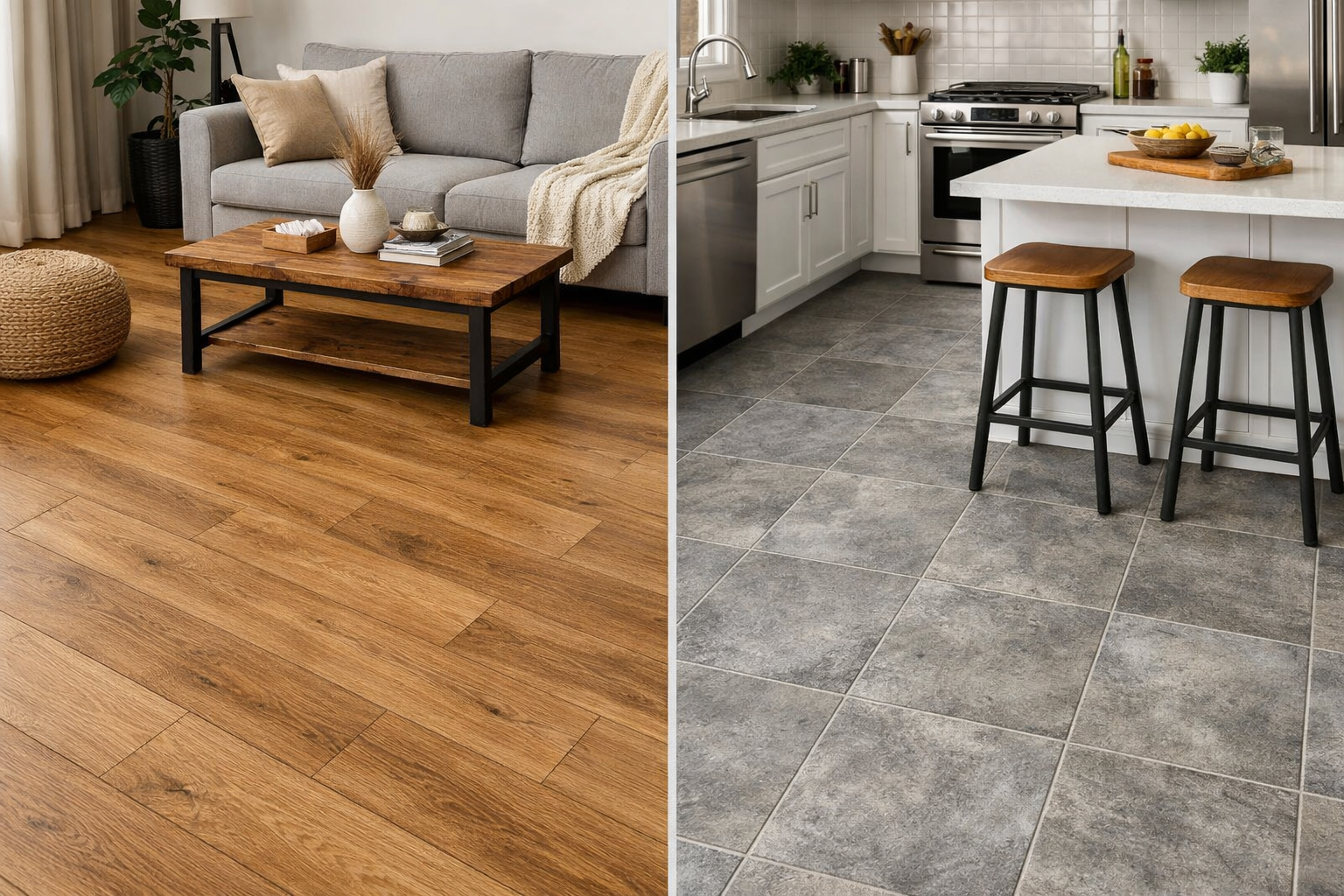
LVP and LVT are both luxury vinyl products. The main difference is the format—planks vs tiles—and how that format changes the visual story of the room.
Definitions: LVP and LVT in plain terms
- Luxury vinyl plank (LVP): long plank shapes designed to mimic hardwood visuals.
- Luxury vinyl tile (LVT): square or rectangular tiles designed to mimic stone, ceramic, or patterned tile looks.
Design implications: why format matters
Because the pieces are shaped differently, they encourage different layouts:
- Choose LVP when you want continuous “wood floor” visuals across open plans or you’re trying to visually enlarge a space with longer lines.
- Choose LVT when tile aesthetics fit the room—kitchens, entries, laundry rooms—or when you want patterns (herringbone, checkerboard, modular looks).
- Consider groutable LVT if replicating true tile is important; it can create a more authentic tile read than non-grouted visuals.
Performance is not determined by plank vs tile
LVP and LVT share the same performance fundamentals: wear layer, core stability, texture, and installation quality. In other words, don’t assume “tile” is tougher than “plank” just because it looks like stone; compare the build.
If your goal is “make this space feel like real hardwood,” start with LVP. If your goal is “tile vibe without tile maintenance and coldness,” start with LVT—then compare specs.
Waterproof Flooring and Water-Resistant Claims: How to Read the Fine Print
“Waterproof” is one of the most powerful words in flooring marketing, and it can also be one of the most misunderstood. The key is separating topical spill protection from whole-room water events (like leaks, overflow, or long-term moisture).
What “waterproof flooring” usually means
In many product lines, “waterproof” means the floor’s surface and core are designed to resist swelling and damage from everyday spills—especially compared with wood-based cores. That’s valuable, but it does not mean water can’t reach the subfloor.
Water-resistant vs waterproof
- Water-resistant: handles occasional splashes and quick cleanup, but seams/edges may be vulnerable with prolonged exposure.
- Waterproof (typical usage): better tolerance for spills and wet use, but still requires prompt attention to leaks and standing water.
The joint is the real test
Even when the surface is water-tolerant, water can migrate at the seams. Ask how the flooring system manages water at the joints:
- Sealed bevels or edge treatments that reduce seepage pathways
- Tight click profiles engineered for strong locking pressure
- Manufacturer-approved underlayments and installation methods that maintain joint integrity
“Waterproof” doesn’t mean “flood-proof.” It usually means “spills won’t ruin the planks if handled reasonably quickly”—not that your subfloor is protected from a slow leak.
Best practice for wet-prone rooms
For bathrooms, mudrooms, and laundry areas, prioritize moisture-smart systems and installation discipline:
- Maintain proper perimeter expansion gaps (floating floors need room to move).
- Use correct transitions and thresholds to manage movement and water risk.
- Address plumbing and appliance connections proactively—flooring can’t compensate for chronic leaks.
Click-Lock (Floating) Floors: Snap-Lock Installation Across Materials
Click-lock (also called snap-lock) flooring refers to the interlocking edge system that lets planks or tiles connect without nails or full-spread glue. Installed correctly, a click-lock floor “floats” over an underlayment rather than being mechanically fastened to the subfloor.
Where click-lock shows up
Click-lock systems are common in:
- Laminate flooring
- LVP and LVT vinyl
- Some engineered hardwood products
Pros: why homeowners like floating floors
- Speed: fewer steps than nail-down or full glue-down installs in many projects.
- Cleaner installation: reduced adhesive use for many click systems.
- Repair potential: depending on layout and access, it can be easier to replace sections than with some glued floors.
- Comfort and sound: underlayments can improve feel and acoustics.
Cons: what click-lock requires to succeed
Floating floors are less forgiving about the substrate. If the subfloor isn’t flat enough, you can see issues like movement, noise, or joint stress over time.
- Subfloor flatness: critical for joint longevity and to prevent “bounce.”
- Expansion space: floating floors must be able to move with temperature/humidity changes.
- Transitions: doorways and long runs require correct transitions to avoid pinching the floor.
If you want the speed of click-lock, budget time (and money) for subfloor prep. The joint is only as strong as the surface supporting it.
Sheet Vinyl Flooring: Seam-Minimizing Coverage for Wet-Prone Areas
Sheet vinyl is sometimes overlooked because planks and tiles dominate social media. But for wet-prone rooms, sheet vinyl remains one of the most practical—and often most budget-friendly—solutions available.
Why sheet vinyl works so well in kitchens, baths, and laundry rooms
Sheet vinyl comes in rolled goods that can cover large areas with fewer seams. Fewer seams typically means fewer pathways for water to work its way down during daily messes.
- Moisture management: seam-minimizing coverage can be a real advantage in splash zones.
- Comfort: softer underfoot than tile; often warmer and quieter as well.
- Easy cleaning: practical for households that prioritize simple maintenance.
- Cost control: a strong option for budget-conscious renovations where function matters most.
The catch: subfloor prep is non-negotiable
Sheet vinyl can “telegraph” subfloor imperfections—meaning bumps, debris, or uneven patches can become visible through the finished surface. A smooth, clean substrate is essential for a good-looking, long-wearing result.
Style isn’t limited to “basic” anymore
Design options range from realistic stone visuals to bold patterns. If traction matters (and it often does in wet-prone rooms), confirm slip resistance and wear specs rather than choosing on visuals alone.
For a laundry room or secondary bath, sheet vinyl can be a quietly excellent choice: practical, seam-reducing, and easier on the budget—without sacrificing a clean modern look.
Conclusion: Match the Floor to the Room, Then to Your Style
Choosing among laminate, hardwood, engineered hardwood, vinyl (LVP/LVT), click-lock systems, waterproof claims, and sheet vinyl is easier when you evaluate floors the way pros do: by performance requirements first and aesthetics second.
- Laminate is a strong value for scratch resistance and style—just treat moisture as the main risk factor.
- Solid hardwood offers unmatched authenticity and refinishing potential—best for controlled-moisture areas.
- Engineered hardwood provides real wood with added stability and flexible installs—veneer thickness is key.
- Vinyl (resilient) is versatile and water-tolerant—compare wear layer and core, not just the look.
- LVP vs LVT is primarily about format and design goals—performance still comes from construction and install quality.
- Waterproof is helpful but not magic—seams, subfloor protection, and leak response still matter.
- Click-lock can be fast and practical—subfloor flatness and expansion gaps make or break the result.
- Sheet vinyl remains a smart, seam-minimizing option for wet-prone rooms—prep determines how good it looks.
Choose Your Flooring with Confidence
List your room conditions (moisture, traffic, pets, sunlight) and compare product specs—wear layer, core, installation type, and warranty—to narrow the best flooring material and product type for your home.
Next step: walk through your home and jot down one line per room—what it needs to survive. Then bring that list when you shop, and ask for spec sheets that confirm the details that matter.