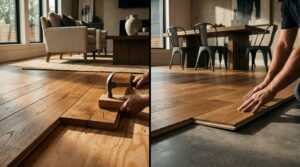
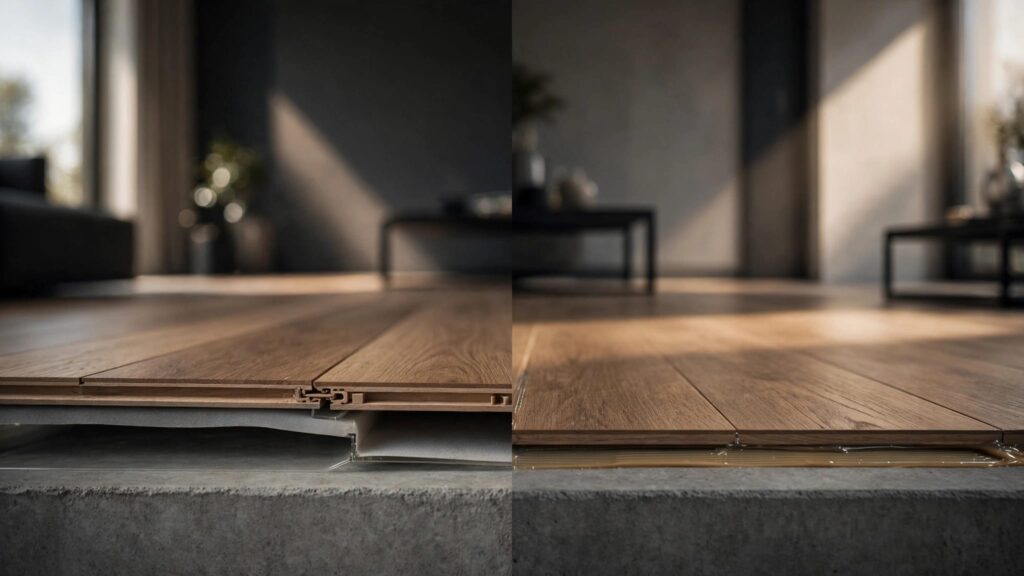
A concrete slab can look flat and dry, yet still cause a new floor to flex, separate, or release from the surface. With floating vs glue-down LVP, the better choice depends first on slab moisture, flatness, movement, and room use, not only plank appearance.
For Denton, Argyle, Flower Mound, and nearby North Texas homes, both methods can work over a properly prepared concrete slab. Click-together vinyl uses interlocking planks, while glue-down flooring bonds directly to the surface. Neither system can correct slab defects, so evaluate moisture, flatness, sunlight, traffic, and room use before selecting the product.
Start with the slab, then choose the vinyl plank flooring system that fits it.
Floating vs glue-down LVP: the short answer
Floating vinyl flooring uses luxury vinyl plank that clicks together and rests over the prepared slab. It isn’t attached across the full floor, so the assembled surface can accommodate limited movement.
Glue-down vinyl flooring bonds each plank directly to the concrete with a compatible adhesive. It creates a firmer, lower-profile surface, but adhesive work and slab preparation must be more exact.
A floating system is often the practical option for a typical residential flooring update. It usually installs faster, feels slightly more cushioned underfoot, and allows access to individual planks when a repair is possible.
Glue-down LVP usually makes more sense where rolling loads, frequent traffic, or wide open spaces call for a firmer floor. Its lower profile can also help when matching adjacent tile or exterior doors.
| Factor | Floating click-lock LVP | Glue-down LVP |
|---|---|---|
| Attachment | Planks lock together above the slab | Each plank bonds to the slab |
| Subfloor moisture | Slab moisture must meet product limits | Slab moisture must meet adhesive and product limits |
| Underfoot feel | Often softer with approved underlayment | Firmer and closer to concrete |
| Floor movement | Allows limited movement within the assembled floor | More restrained after the adhesive cures |
| Installation difficulty | Usually simpler after slab prep | More exact layout, adhesive, and rolling work |
| Installation pace | Often faster once the slab is ready | Usually slower because adhesive work is required |
| Repair access | May require unlocking planks from a wall | A damaged plank can sometimes be removed locally |
| Best fit | Most homes, bedrooms, and living areas | Busy entries, rentals, offices, and commercial flooring |
The main point is simple: neither method can overcome a slab that has moisture or major flatness problems.
How each LVP installation method works
Floating click-lock installation
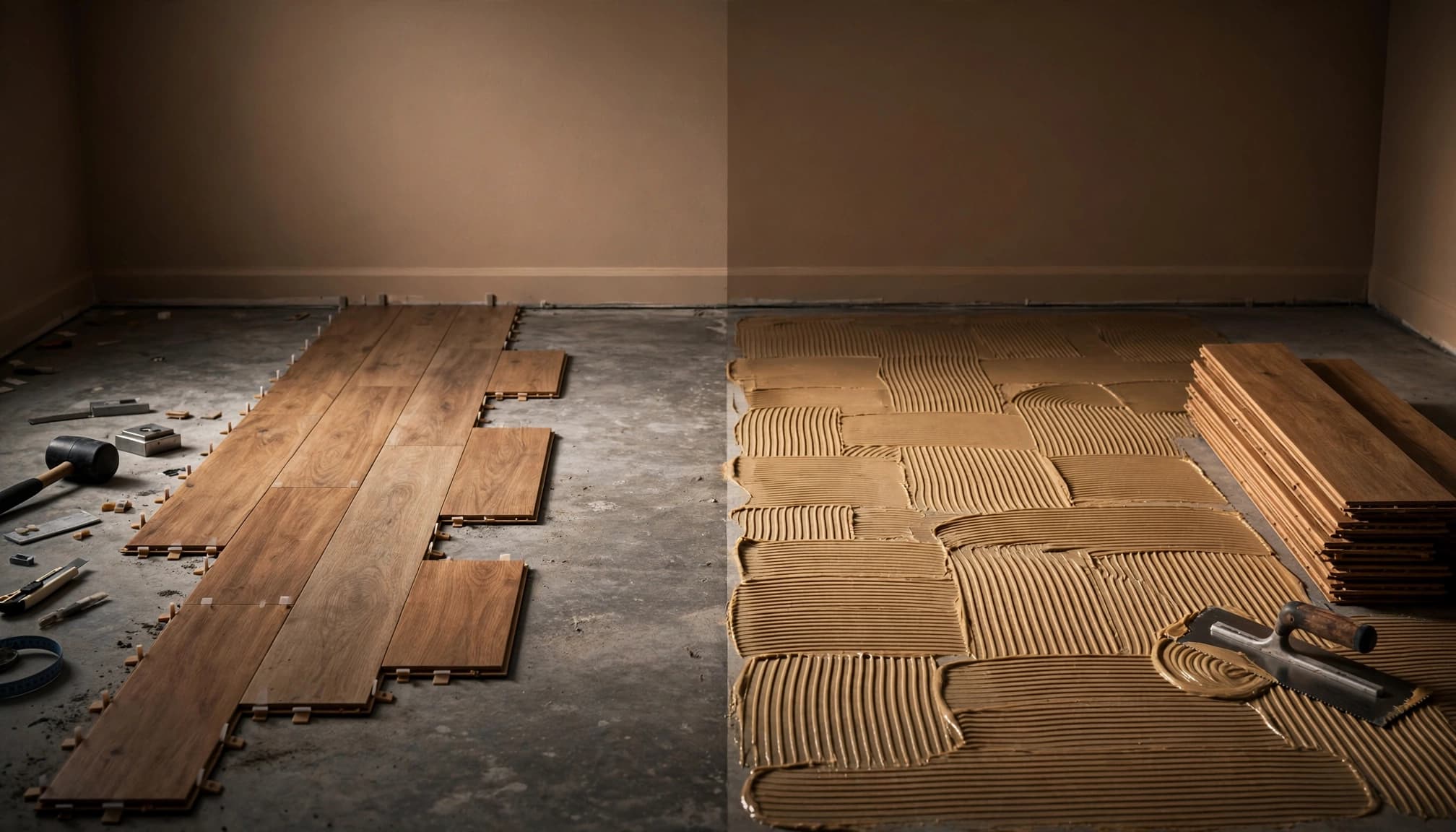
Floating vinyl flooring uses a click-lock system. The click-together vinyl planks lock to one another, while a perimeter expansion gap allows expansion and contraction during normal temperature changes.
Many homeowners choose this method during a floor replacement because it avoids spreading adhesive across every square foot. The finished floor may also provide sound absorption or noise reduction when the complete tested assembly supports those claims.
That doesn’t make floating LVP a shortcut. If the slab has a low area, the floor can flex when you walk across it. Repeated flexing may stress the locking edges, especially in a kitchen walkway or hallway. Use only the underlayment approved by the plank manufacturer. An acoustic rating applies to the tested floor assembly, not automatically to every home.
Glue-down dryback installation
Glue-down luxury vinyl plank has no click-lock profile. This direct-glue installation starts with adhesive application over a prepared section of slab, followed by the specified tack or open time. The installer then places and rolls the planks to create full contact.
Because every plank is secured, glue-down vinyl flooring usually feels firmer and can reduce surface movement under chairs and rolling loads. That can be a strong fit for a home office, a busy entry, a rental property, or light commercial flooring.
The tradeoff is that adhesive work leaves less room for error, and glue-down floors are less forgiving of slab defects. Concrete must be clean, smooth, dry within the adhesive system’s limits, and free of old glue or dust. A professional installer should follow the exact plank and adhesive instructions, not a generic rule from another brand.
Prepare the concrete slab before choosing a floor
Test moisture instead of guessing
Waterproof flooring resists spills from above. It does not provide moisture protection for a damp slab.
Concrete can hold moisture long after it looks dry. Some floating products permit higher readings than certain glue-down systems, but the product guide controls. These limits are not interchangeable between products or adhesive systems. For example, COREtec Pro SPC installation guidelines list a maximum of 8 pounds per 1,000 square feet over 24 hours under ASTM F1869 testing. An EverStep glue-down installation guide lists 3 pounds and 80% relative humidity for that particular adhesive system.
Ask which test is being used, where it will be taken, and what the selected product allows. ASTM F2170 measures in-situ relative humidity within the slab, while ASTM F1869 measures moisture vapor emission. Existing slabs with a previous floor covering may need more investigation than a newly poured slab.
A moisture reading is only useful when it is compared with the exact limits in your plank and adhesive warranty documents.
Correct flatness, cracks, and residue
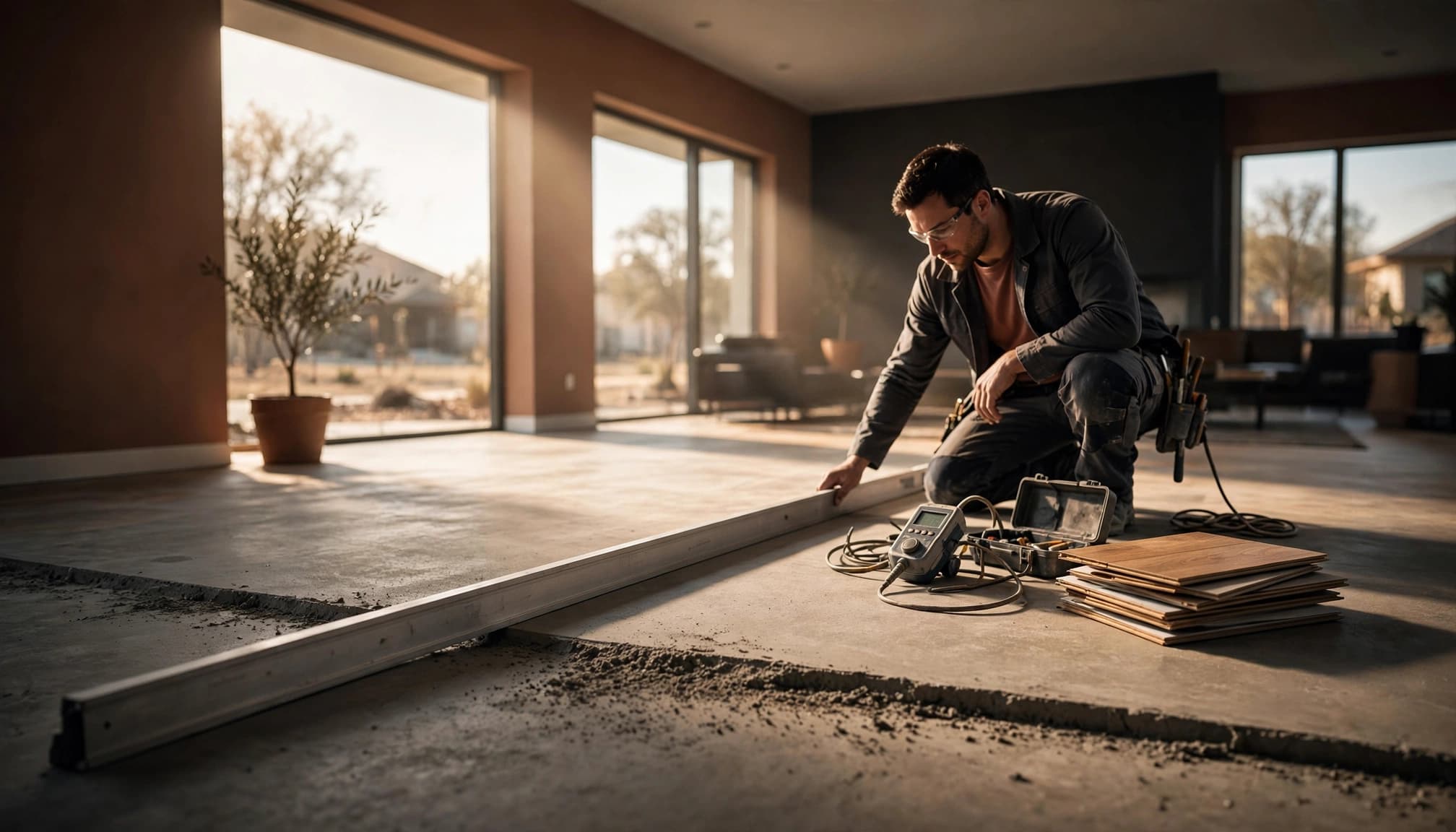
Click-lock LVP needs stable, flat support. An uneven subfloor can let floating planks flex, while ridges, cracks, dust, and debris can telegraph through glue-down vinyl flooring.
Proper subfloor preparation starts with removing loose material, grinding high spots, filling suitable low areas, and addressing cracks as the product system permits. Complete this work before flooring installation begins. Adhesive residue from old carpet, sheet vinyl, or tile mastic can interfere with a glue bond.
North Texas slab foundations can experience seasonal movement. That does not mean every crack is a flooring emergency, but it does mean you should identify active issues before covering them. Floor leveling, crack treatment, and moisture mitigation depend on the selected system. Review flooring options for Texas slab foundations before choosing a material based on appearance alone.
Control the home environment
Keep the home operating under normal living conditions before, during, and after installation. Air conditioning matters during Denton’s hot summers, especially when a room has large west-facing windows.
Acclimation requirements differ by manufacturer. Some products need a set indoor temperature range for 48 hours before installation. Keep cartons indoors as directed, protect them from direct sun, and do not leave a newly installed floor in an unconditioned home.
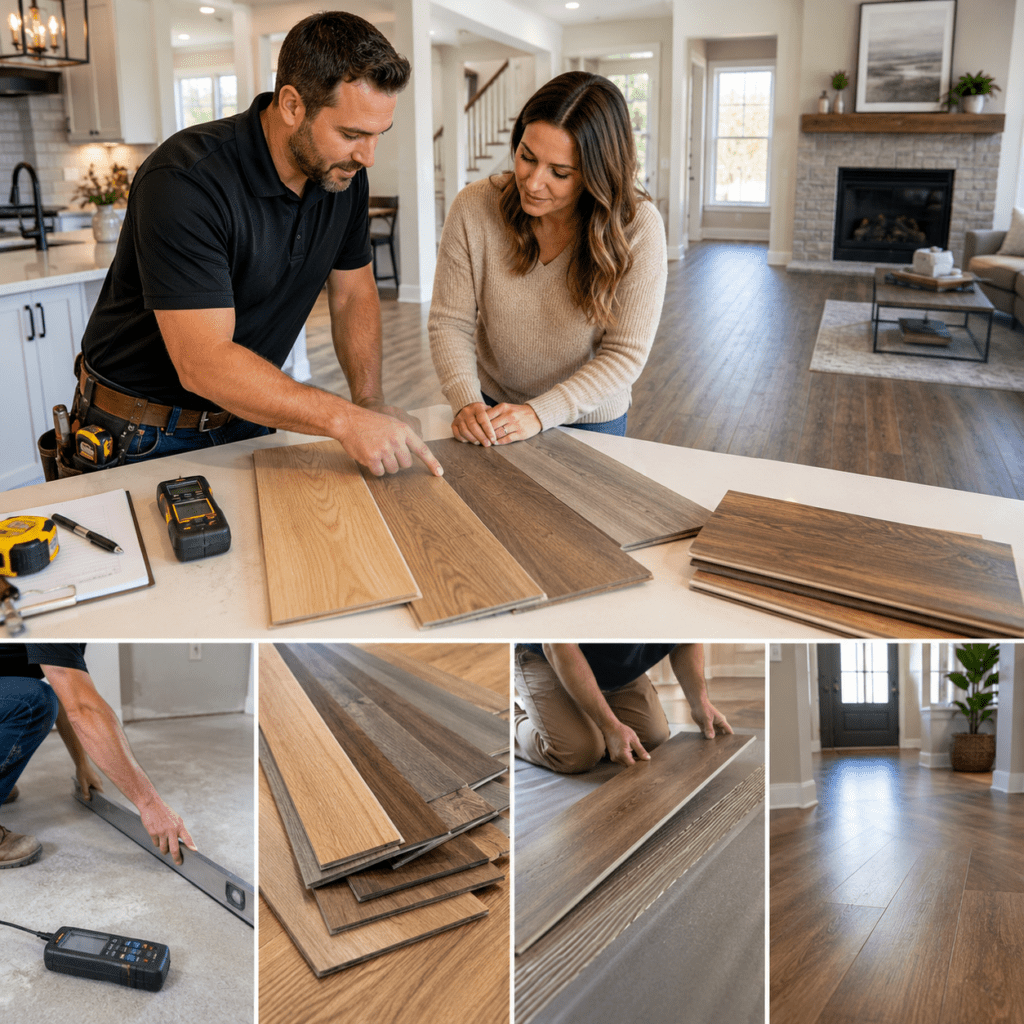
If you want the slab evaluated before ordering material, Get Your Free Flooring Estimate with JBN Flooring. You will get a clear scope for preparation, removal, installation, trim, and transitions.
Match the installation method to the room
Choose floating LVP for comfortable residential spaces
Floating vinyl flooring is often a good fit for bedrooms, living rooms, dining rooms, and many whole-home updates in Corinth, Lantana, Highland Village, and Little Elm. On a prepared concrete slab, it can install quickly and offer a slightly less rigid feel when the product allows it.
It provides a broad range of wood-look styles without hardwood’s maintenance demands. A floating system may also make future access easier if a plank gets scratched or damaged.
However, a middle-of-room repair isn’t always quick. Installers may need to disassemble flooring from the nearest wall to reach the damaged plank without harming surrounding locks.
For most family homes, a quality click-lock product with a suitable wear layer and careful slab preparation offers a dependable balance of comfort, appearance, and maintenance.
Use glue-down where movement and traffic are constant
Glue-down is worth considering in high-traffic areas, including busy entries, home offices, home gyms, rentals, and rooms where chairs or furniture move often. It limits surface movement and can reduce the hollow sound that occurs when floating flooring bridges a shallow low spot.
A direct bond can also help maintain a low profile where you need a thinner finished floor. Still, glue-down doesn’t eliminate all movement, and the work requires exact surface preparation, proper adhesive open time, and thorough rolling.
The same reasoning applies to commercial flooring, though room conditions and product specifications still matter. For Denton flooring projects, ask for both options in writing. A properly prepared floating system and a properly installed glue-down system can both offer durability and stability.
Be cautious over existing floors and sun-heavy rooms
Floating LVP may install over existing tile or hardwood when the surface is sound, flat, dry, and approved by the manufacturer. Loose tile, soft wood, uneven grout lines, and excessive floor height can rule it out.
Don’t cover an existing floor simply to avoid preparation. Removing the old surface may reveal a better path for transitions, doors, and long-term floor repair.
Rooms with intense direct sunlight also deserve attention. Use window coverings, follow the product’s temperature limits, and avoid installation in spaces without consistent climate control. If you’re comparing LVP with laminate flooring, luxury vinyl tile, or engineered hardwood, review each product’s format and manufacturer instructions before assuming they behave the same way on a slab.
Budget for preparation, not only planks
Material and installation costs vary by product quality, room layout, furniture moving, demolition, slab condition, trim work, and labor. For a concrete slab home, total pricing also depends on moisture testing, floor leveling, patching, transitions, and layout complexity. JBN Flooring’s local vinyl flooring installation cost guide gives installed vinyl plank flooring as a broad example, ranging from $3 to $12 per square foot. These figures aren’t guarantees. The guide lists floor leveling at roughly $1 to $3 per square foot and old-floor removal at about $1 to $4 per square foot.
Floating LVP may reduce labor time because it doesn’t require full-spread adhesive. Glue-down vinyl flooring can increase labor costs through adhesive application, layout, rolling, and additional surface work. Commercial flooring labor assumptions shouldn’t transfer directly to a residential slab quote. A floating floor over an unprepared slab can also cost more later if joints fail.
Ask your flooring company for an itemized estimate with separate line items for:
- Removal and disposal of the existing floor.
- Moisture testing, slab preparation, patching, and floor leveling.
- Materials, underlayment, adhesive, and installation supplies.
- Trim, transitions, furniture moving, cleanup, and final walkthrough details.
A written scope helps you compare professional flooring installation quotes fairly in Plano, Frisco, Southlake, Keller, Grapevine, and surrounding communities.
Maintain LVP and plan for repairs realistically
Keep grit, standing water, and heat under control
Luxury vinyl plank handles everyday spills well, but it still benefits from routine care. Sweep or vacuum with a hard-floor setting, clean with a manufacturer-approved neutral cleaner, and wipe standing water near exterior doors or pet bowls.
Use felt pads under furniture and protect floors from sharp chair legs. Avoid steam cleaners unless the manufacturer explicitly permits them. Excess heat through glass doors or large sunny windows can also stress a floating floor.
Treat movement as a symptom, not a cosmetic flaw
A raised edge, soft spot, opening seam, or plank lifting at a doorway needs inspection before random replacement. First determine whether the problem comes from slab flatness, moisture, a damaged locking edge, adhesive failure, or an inadequate perimeter gap.
A trained installer may remove a glue-down plank locally, but the work can damage surrounding adhesive or the slab surface. Floating repairs may require disassembling several rows from a wall, especially when damage occurs in the middle of the room.
Neither method makes every repair simple. Matching replacement planks may be unavailable or vary by dye lot, production run, or discontinued product. The slab and installation system should be evaluated before ordering material or replacing random pieces.
For an honest assessment, use JBN Flooring’s floor repair services in Denton before deciding between targeted repair and full replacement.
Frequently asked questions about LVP on concrete
Is floating LVP easier to install yourself?
Usually, yes. Click-lock planks make DIY installation more approachable than spreading adhesive. Success still depends on moisture testing, flatness correction, plank acclimation, layout, perimeter gaps, and transitions. A poor subfloor can damage click joints regardless of who installs them.
Is glue-down LVP better for a concrete slab?
Glue-down can be an excellent choice for a properly prepared concrete slab in high-traffic spaces. It provides firm performance under rolling loads and heavy use. A floating system may be a better fit for many ordinary residential rooms when the product and slab permit it. It can also offer a faster installation and potential access for future plank replacement.
Can either type of LVP go in kitchens and bathrooms?
Both can work if the selected product is rated for the room and the slab meets its installation requirements. Waterproof planks don’t provide complete moisture protection for the slab, wall edges, cabinets, or floor penetrations. Good transitions and quick cleanup still matter, and the slab must meet the product’s moisture requirements.
How do I choose between LVP and engineered hardwood?
Engineered hardwood offers real wood texture and can be refinished only when its wear layer allows it. LVP flooring is generally easier to maintain around pets, spills, and busy family routines. Your slab moisture results, desired look, and tolerance for maintenance should make the decision.
For a property-specific recommendation from a local flooring contractor, Call 469-340-0837 and discuss your slab, room use, sunlight, and existing floor.
Choose the system that respects your slab
The best floor installation starts with moisture testing and slab preparation, not a quick choice between click-lock and adhesive. Floating LVP often suits ordinary residential rooms when the slab is dry, flat, and properly prepared. Glue-down LVP can be better for rolling loads, frequent traffic, lower finished-floor height, or a firm directly bonded feel.
Your home doesn’t need the same flooring system as your neighbor’s. The LVP installation decision should account for moisture, slab movement, sunlight, repair access, product warranty, and total labor. Correct preparation and installation support durability and stability, regardless of the system. Compare written scopes for moisture testing, preparation, installation, trim, and warranty requirements before choosing a contractor.