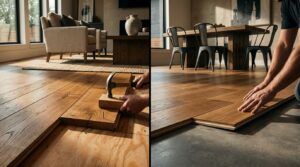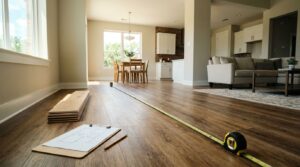
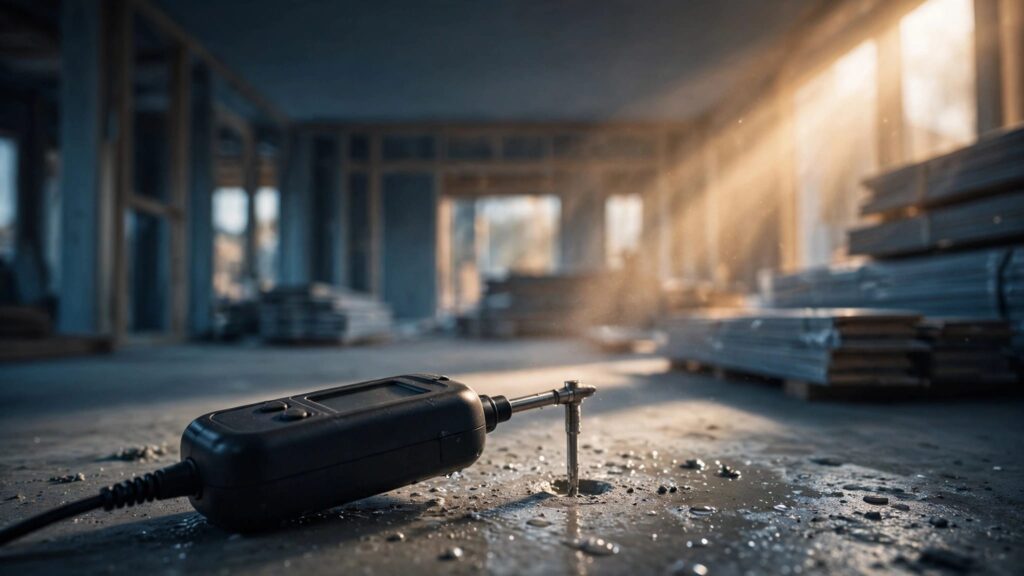
A concrete slab can look dry while its moisture content remains high enough to damage new flooring. That’s why concrete moisture testing should happen before materials arrive, not after installation problems appear.
In Denton, Argyle, Flower Mound, Frisco, and surrounding North Texas communities, hot summers, high humidity, storms, leaks, and unconditioned homes can all affect a slab. Your flooring contractor needs documented readings, not a guess based on appearance.
The right readings help you choose suitable materials, adhesives, and preparation for a floor that stays stable.
Key Takeaways
- Concrete can look dry while retaining enough moisture to damage flooring, adhesives, underlayment, and trim.
- Test the slab after the home reaches normal indoor temperature and humidity, and use the ASTM method required by the selected flooring and adhesive system.
- ASTM F2170 relative humidity testing, ASTM F1869 calcium chloride testing, plastic sheet screening, and electronic meter scans provide different types of information and are not interchangeable.
- Test multiple representative areas, investigate leaks or drainage issues, and address cracks, residue, leveling, alkalinity, and other slab conditions before installation.
- If readings exceed product limits, allow additional drying time, repair water sources, or use a manufacturer-approved moisture mitigation system before installing new flooring.
Why concrete moisture testing protects your new floor
Concrete can release moisture long after it cures. Water vapor may move upward from the ground or from water stored inside the concrete. When floor coverings seal the surface, that vapor has fewer escape paths.
Built-up pressure can soften adhesive or loosen glued-down flooring. It can also cause odors and discoloration beneath vinyl. Laminate cores may swell, while hardwood flooring can develop gaps.
Waterproof LVP protects against spills from above. It doesn’t make an inadequately prepared slab safe underneath. A floating LVP floor may hide a moisture problem for a while. Trapped moisture can still cause mildew odors, weakened transitions, or damaged baseboards.
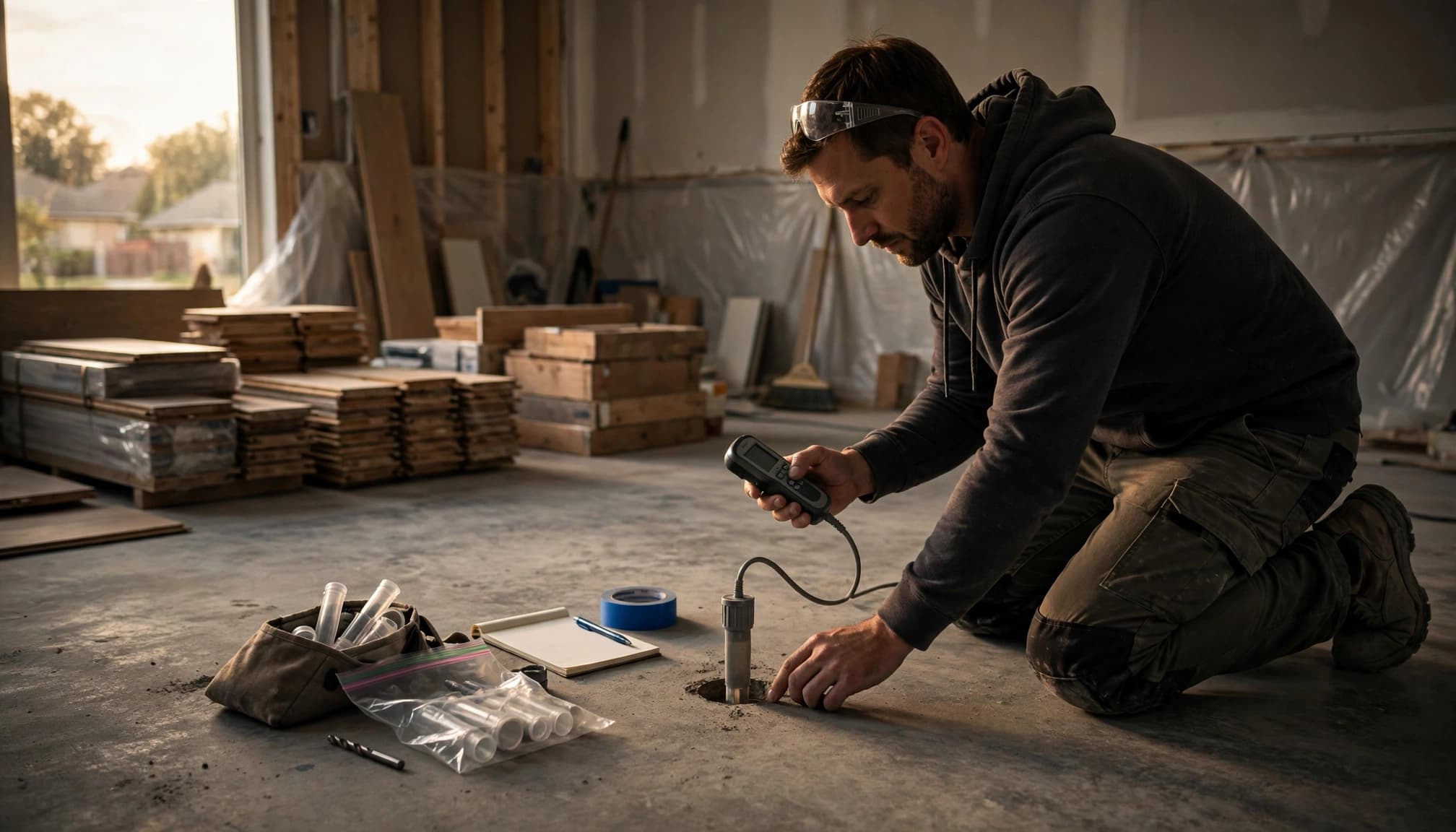
Before a floor replacement, inspect for signs of an existing issue. Darkened concrete, efflorescence, musty odors, loose vinyl, swollen laminate edges, or damaged trim deserve attention. Address these problems before new flooring covers the evidence.
A floor can only perform as well as the slab, adhesive, underlayment, and installation method allow.
For a clear on-site plan in Denton County, Get Your Free Flooring Estimate before committing to a material or installation date.
North Texas slabs need stable indoor conditions
North Texas weather can change quickly. September may bring hot afternoons, humid mornings, and sudden storms. In a house with open windows, inconsistent air conditioning, or recent construction, a slab may absorb or retain more moisture than expected.
Run the HVAC before testing
Your home’s HVAC should operate at normal living conditions before testing and throughout installation. Test after the home reaches its usual occupied temperature and humidity, rather than immediately after it is closed up. These ambient conditions provide a more realistic picture of how the slab will behave.
Many flooring systems also set limits for room temperature and indoor relative humidity. Mohawk technical guidance, for example, calls for 65 to 85 degrees Fahrenheit and 45% to 65% relative humidity during installation for certain products and adhesives. Those ranges aren’t universal, so the selected flooring and adhesive documentation controls.
Look beyond normal curing time
New concrete is often described as needing about 28 days to cure. Curing and drying concrete are different processes. A slab may gain strength while its internal moisture content remains too high for a chosen adhesive or flooring system.
Existing homes can have moisture concerns, too. A foundation drainage issue, irrigation near the slab, a dishwasher leak, or a past plumbing repair can change readings in one room. North Texas flooring work should account for the actual house, not only the age of the concrete.
Concrete moisture testing methods and what each one tells you
Different test methods answer different questions. The ASTM standard identifies the procedure, while the flooring and adhesive manufacturer sets the pass or fail limit for that product.
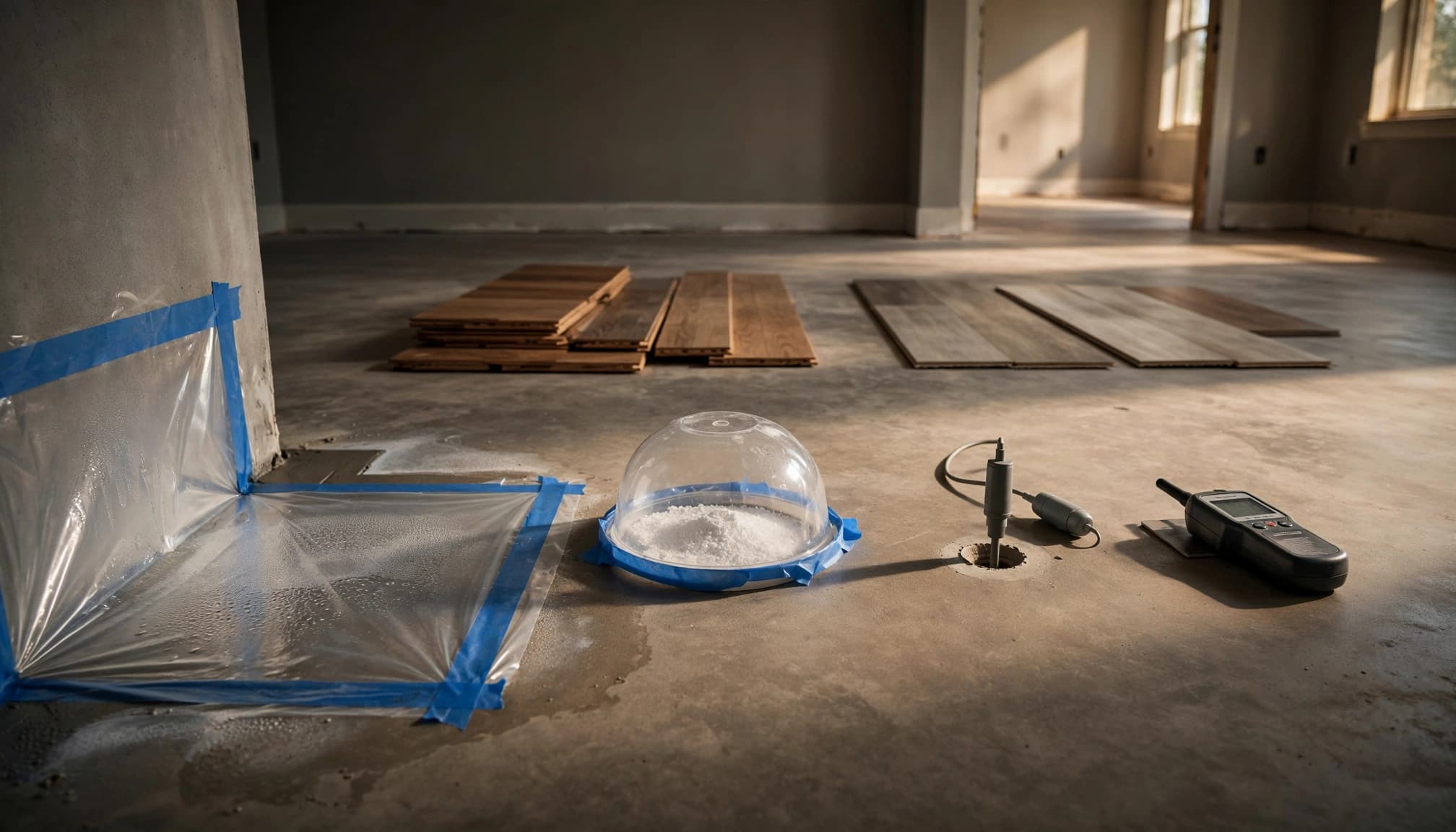
ASTM F2170 relative humidity testing
ASTM F2170 uses in situ probes installed in drilled holes in the slab. Probe placement and stabilization must follow the ASTM procedure.
After the relative humidity probes stabilize, they measure relative humidity inside the slab rather than only surface conditions. The AMPP’s overview of concrete moisture testing describes how these probes measure conditions inside drilled slab holes.
For adhesive-dependent installations, such as glue-down engineered hardwood or vinyl flooring, ASTM F2170 readings often carry more weight when product documentation calls for internal RH data.
ASTM F1869 calcium chloride test
The procedure measures moisture vapor emission rate, often called MVER. A test dish sits under a sealed cover on the slab, and the amount absorbed determines the result.
In this test, moisture vapor emission rate reports vapor leaving the surface in pounds per 1,000 square feet per 24 hours.
ASTM F1869 may be required because some adhesive instructions still list an MVER limit. It reports a specific result, not broader moisture vapor transmission through or from the slab. It isn’t interchangeable with F2170.
ASTM D4263 plastic sheet method
This screening approach is simple. A technician tapes an 18-by-18-inch plastic sheet tightly to the slab for roughly 16 to 24 hours. Condensation under the sheet or darker concrete may point to moisture.
Use it as an early warning, not final approval. ASTM D4263 is qualitative, so it can’t provide the quantitative measurement needed for many flooring warranties or manufacturer requirements.
ASTM F2659 electronic meter scanning
A non-destructive moisture meter scans the upper portion of the slab. These concrete moisture meters help compare surface zones, locate wet-looking areas, and identify where formal testing is needed.
DeFelsko’s explanation of concrete moisture measurement distinguishes this preliminary scan from formal RH readings. These tools can support an inspection, but they don’t replace a required RH or MVER test.
| Test method | What it measures | Typical use |
|---|---|---|
| RH probe testing | Internal slab relative humidity | Supports decisions when product documentation calls for RH data |
| Calcium chloride procedure | Vapor emission at the surface (MVER) | Used when adhesive instructions specify an MVER limit |
| Plastic sheet screening | Condensation or darkening under plastic | Qualitative screening only |
| Electronic meter scan | Comparative surface-zone readings | Locating possible problem areas |
The right approach often combines a meter scan with the test required by the selected product.
How to read moisture results before floor installation
There is no universal “safe” moisture number for every floor. Readings can vary across a concrete slab. The acceptable result depends on selected floor coverings, adhesive, underlayment, moisture mitigation, and the manufacturer’s written instructions.
Follow the complete installation system
One resilient flooring adhesive may limit installation to 6 pounds MVER or 86% RH. A more moisture-tolerant system may permit a higher RH reading, sometimes up to 95% RH under defined conditions. These figures are examples for named products and adhesive systems only.
Don’t compare a neighbor’s vinyl installation limit to yours. Even two products from the same manufacturer may require different preparation. Sika’s discussion of concrete test methods also notes that RH probes need time to stabilize before readings guide a flooring decision.
Test more than one location
Moisture rarely behaves evenly across an entire home. A slab near an exterior wall, bathroom, laundry area, patio door, or former leak may read differently than the middle of a living room.
A professional flooring installation should test representative areas. It should also inspect surface conditions for cracks, patching compounds, adhesive residue, high spots, and alkalinity and pH concerns. Moisture testing is one part of slab preparation, not the whole job.
Match the flooring type to your slab and daily life
Your material choice should reflect the moisture content results and how you use the room. A good flooring company won’t push one answer for every home in Corinth, Highland Village, or Lewisville.
Luxury vinyl plank and vinyl flooring
Luxury vinyl plank is popular for kitchens, hallways, rentals, and homes with pets because its wear layer resists everyday spills. However, a waterproof wear layer doesn’t automatically tolerate moisture from below through concrete floors. LVP flooring also needs a flat, clean substrate and a product-approved installation method.
When readings are within the product’s limits, a floating waterproof LVP system can be a practical choice for busy rooms. Learn more about waterproof LVP flooring installation when you want a wood-look floor with low-maintenance cleanup.
Engineered hardwood, laminate, and solid wood
Engineered hardwood gives you a real wood surface with more dimensional stability than solid hardwood. Yet it still requires careful moisture testing, especially when you plan a glue-down installation over concrete. Explore engineered wood installation in Denton if you want the warmth of wood without treating slab preparation as an afterthought.
Laminate flooring can offer strong scratch resistance and a lower material cost. Moisture can permanently swell its fiberboard core at the edges or joints. Solid hardwood generally needs the strictest moisture planning over a slab and may require a different system, or may not be suitable under the selected manufacturer’s instructions.
What happens when the slab does not pass
A high reading doesn’t automatically end your project. It means pause and find the source. Then choose a remedy that suits the flooring system.
First, rule out active water problems. Check plumbing leaks, wet exterior grading, gutter discharge, failed door seals, and moisture around a foundation wall. A floor repair may fix loose planks or damaged trim, but it won’t stop water entering the house.
Next, allow more drying time under normal HVAC conditions when the source is temporary. Drying time varies. Continued moisture vapor transmission from below can keep readings high after a visible leak is repaired. Retest before installation. A professional may be needed when readings remain high or active water is present. Damage and odors may also require professional help when they indicate a broader problem.
In other cases, moisture mitigation may involve manufacturer-approved protective coatings, a primer, membrane, or another mitigation system. The system must be approved for the specific flooring and adhesive combination. Some approved assemblies may include vapor barriers. Still, an underlayment or vapor barrier isn’t a universal cure and must be compatible with the product warranty.
Never cover a known slab problem with underlayment and hope for the best. That shortcut often turns a manageable preparation step into a larger floor repair later.
If your old floor has lifted, buckled, or developed a musty odor, schedule a Denton floor damage assessment before choosing replacement materials. You can also Call 469-340-0837 to discuss the slab, the room, and your realistic options.
A practical pre-installation plan for homeowners
You don’t need to buy testing equipment or interpret technical data sheets alone. Ask the flooring installers to explain the test, the manufacturer’s requirement it supports, and any proposed preparation.
Consumer moisture test kits aren’t a substitute for ASTM testing or product-specific documentation. Concrete moisture meters are useful screening tools, but their readings may need confirmation through the required ASTM method.
Before residential flooring installation begins, ask for:
- The exact ASTM procedure, test locations, required stabilization time where relevant, and the flooring or adhesive data sheet it supports.
- The locations tested, plus any unusual readings or visible slab conditions.
- The planned preparation, including cleaning, patching, leveling, moisture control if needed, underlayment, adhesive, and removal of damaged materials.
- A written scope that identifies the selected material and installation method.
This matters when comparing estimates. A low quote may omit slab preparation, transitions, old-floor removal, or moisture protection your project needs. A careful flooring installation in Denton starts with the condition of the home, then builds a plan around your priorities and budget.
Final thoughts on protecting your investment
Concrete moisture testing gives you a useful answer before your new floor is at risk. It helps match the slab to the right flooring material, adhesive, underlayment, and preparation plan instead of relying on a surface that only looks dry.
For North Texas homes, proper preparation protects your flooring’s appearance and service life long after installation day.
Frequently asked questions
Is relative humidity testing the best option for flooring?
For many flooring projects, ASTM F2170 is a strong choice because it measures conditions inside the slab. The flooring and adhesive manufacturer, not a generic article threshold, determines the final method and acceptable limit.
Can I install luxury vinyl plank over a damp slab?
Only if the measured condition falls within the flooring system’s written limits and the installer follows the required preparation. Luxury vinyl plank resists spills, but that doesn’t make every slab suitable without testing or preparation.
Will the plastic sheet method tell me if my floor is ready?
It can reveal obvious condensation or darkening, making it a useful quick screen. However, it doesn’t provide the quantitative result required for many warranty-sensitive installations.
How long should I wait after a leak before installing flooring?
Wait until the leak is repaired, the area has dried under normal HVAC conditions, and retesting supports the chosen flooring system. Drying time varies with the slab, the amount of water, indoor conditions, and whether moisture continues to enter from below.